
The Power of Hardscape
Technical Prowess: A meticulously crafted hardscape, showcasing intricate rock formations, dramatic driftwood arrangements, and innovative layouts, undeniably demonstrates impressive technical expertise. Judges acknowledge the skill involved in creating these captivating underwater landscapes.
Beyond Technique: However, technical mastery alone might not guarantee victory. Discerning judges often place a premium on artistic vision. A flawlessly executed hardscape that overwhelms the overall composition or disrupts the flow can detract from the aesthetic appeal.
The Allure of Aquatic Plants
Artistic Palette: Aquatic plants offer a vast and vibrant palette for aquascapers. The diversity in color, texture, and form allows for the creation of visually stunning and meticulously balanced compositions. Lush greenery, pops of color, and meticulously arranged carpets of foreground plants all contribute to the overall artistic impact.
Symbiotic Relationship: Healthy and well-maintained plants play a critical role beyond aesthetics. Thriving plant life fosters a sense of balance within the aquascape, mimicking a flourishing underwater ecosystem. Judges often favor entries where plants complement the hardscape, creating a sense of harmony and ecological well-being.
The Winning Formula: Achieving Balance
The most successful competition entries invariably strike a perfect equilibrium between the artistry of hardscape and the vibrancy of aquatic plants. A captivating hardscape structure serves as the foundation, while meticulously chosen and maintained plants breathe life, color, and visual interest into the underwater scene.
Competition-Specific Strategies:
It's crucial to tailor your approach to the specific competition. Carefully scrutinize the judging criteria to understand the relative emphasis placed on technical prowess and artistic merit. Some contests might prioritize intricate hardscapes, while others might favor a more natural, plant-dominated aesthetic.
Building Your Competitive Edge:
Focus on Cohesiveness: Don't prioritize intricate hardscape elements over the health, composition, and visual appeal of your plant selection.
Learn from the Masters: Analyze past winners' entries to discern the strategies that garnered them recognition. Observe how they achieved balance, artistic merit, and a sense of harmony between hardscape and plants.
Sharpen Your Skills: Continuously refine your abilities in both hardscape creation and plant selection/care. Mastering these distinct yet complementary skills will significantly enhance your competitive edge.
FAQ
In aquascaping, both hardscape and aquatic plants are crucial for a successful and visually appealing aquarium. They play different roles, but work together to create a beautiful underwater world. To get to know it better, we collection full answers uncutted and unedited from our beloved judges/masters who gave their valuable impression to 5 important answers about AQUASCAPING CONTEST related issues.
Q1. we live in a situation in which we observe large structures of extraodinary execution outside the top positions, however we observe that the winning aquariums are highly elaborated. this generates a message that is sometimes difficult for the aquascaper to understand or decipher. what is your opinion on this matter?
i think it's not about the "structure" of the hardscape, but rather the execution of the overall layout. if we look at the few "controversial" designs that have been left out of the top position this year (Matthew, Minh Toan, Steven, Yang Yufan and many others), we will find something in common: they have used a very thin layer of plants to cover their impressive hardscape. It is like modeling: a lot of effort is invested in building the structure and, at the end, it is "colored" with a thin layer of paint. Perhaps this is the reason (I'm not sure) for its exclusion from the top spots.


i think this is the main difference from the few top ranked designs, where similar elaborate structures have been used, but the plantings are different, where we can see real plants growing with different textures and shapes, and not just a layer of plants wrapping the hardscape. So i mean it is not about how the structure/concept looks, big, elaborate, hardscape extravagance are really fine for me, but how to execute the final design in combination with the plants.
— Josh Sim / Malaysia
I completely agree with this affirmation. Year after year the structures and complexity of hardscapes have increased. These are very creative ideas and concepts, where often the aesthetic quality of the material is not that relevant, but the aquascaper, through his talent, transforms his ideas into extremely strong and expressive aquariums.
When it is allowed and the aquascaper sends a photo of the hardscape, i am very excited, because at this way, we can feel and decipher many points of relevance in the work as a whole. We often value the aquarium much more when we understand hardscape work. However, answering your question, i think for those who enjoy work without technical rigor or without the need to thoroughly evaluate the work, what matters most is the sensation and emotion that the work as a whole provides.
This is the ultimate goal of the art! Excite, touch, move our senses and fealings. The expreience of facing a well set aquarium, where the natural atmosphere prevails and the work excites, is one of the greatest pleasures of my professional life. Therefore, i understand that often the most elaborate hardscape is simply a tool or a device so that the talented aquascaper can give his message or tell his story. I get emotional and fulfilled.
— André Longarç / Brazil
I think the essence of this question is probably based on the results of this year's IAPLC, but unfortunately I am not an IAPLC judge, so i don't have a clear answer. However, if I may speak personally as a scaper, I think the focus of the major works, concentrated on the hardscape as a structure.
Had these works focused more on the harmony between plants and landscape, the results might have been different. Of course, this is just mu guess based on IAPLC, but from my point of view as a judge of other competitions, even if it is a work focused on hardscapes, if the quality is beyond imagination, i think should be evaluated at the top. And i think there were actually some works that sould have been rated higher
— Takayuki Fukada / Japan
In my experience, this problem happens when i forgot root of NA when we try to impressed other by structure/ hardscape work. Another reason realted with ths matter is when i spent most time for hardscape work, time for plant to mature is not enough for a contest deadline.
Therefore, we should take a look to true/root of NA art, is created a part of underwater and compare with impressed structure/hardscape works you mention above, we can understand where is the limit of techniques we should use when create NA by simple test with some simple questions:
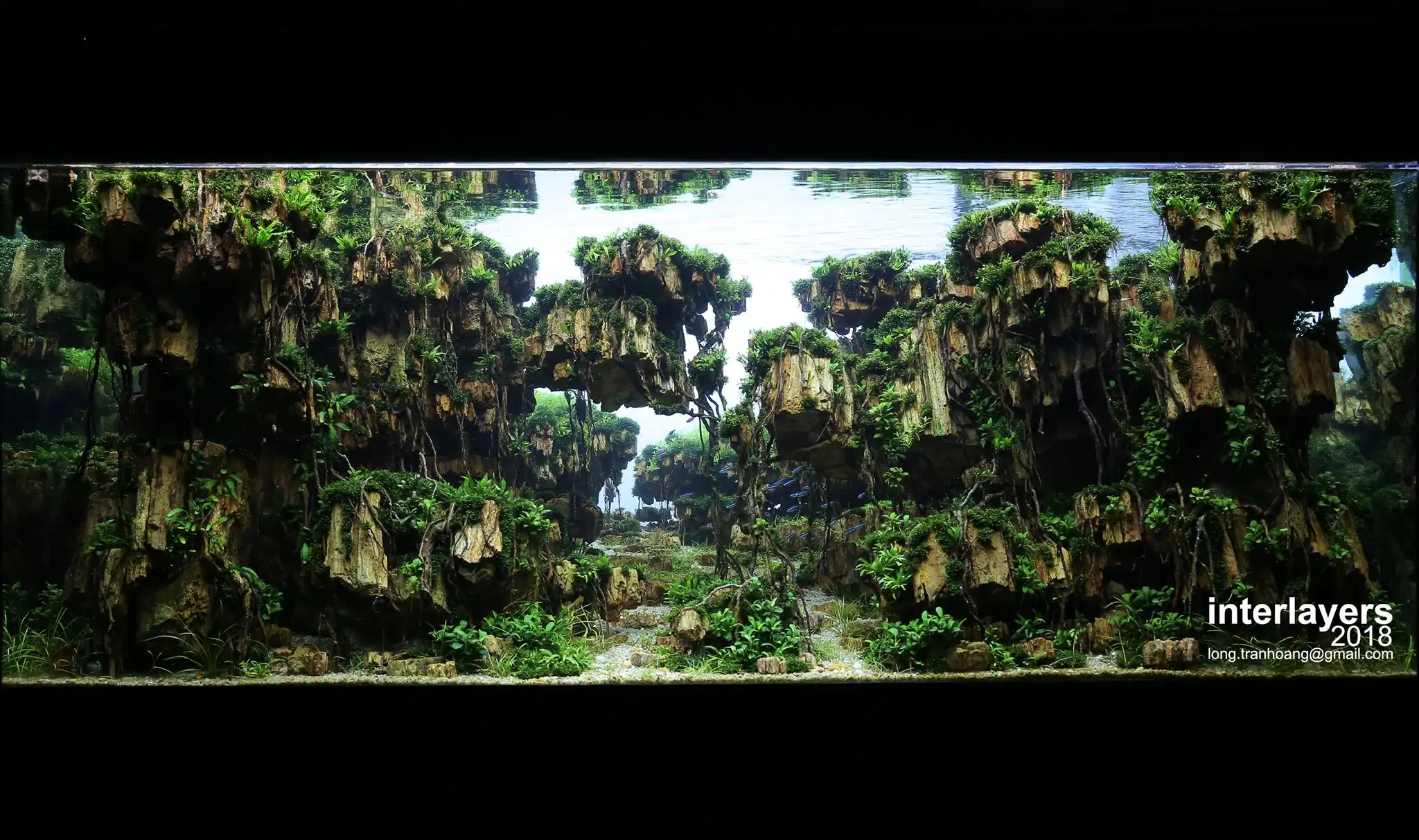
+ This is a real part of underwater nature?
+ This created by nature material?
If answer is No, its mean creator my go out of the lmit of NA, they may created a decoration tank.
— Ant Long Tran Hoang / VietNam
Iam afraid it all depends on which competition we are talking about. It seems to me that this is more about the IAPLC, where it has been the case that the evaluations of the work are incomprehensible. This is applies to both the pre-seletion and the top 100 rankings. I mean that it is not possible to decipher something here and then develop a concept that guarantees a good ranking.
I think that this is not possible in general and especially in relation to the IAPLC to come up with a strategic plan. Strategic behavior leads to pure gambling. In addition, strategic behavior when creating an aquascaper also leads to limiting yourself as an artist and creating something to please others. Then what about your own vision? Where is the original artistic intention to create something from oneself. I think that would be self-denial. And i doubt that aquascapes that will be created like this will be remembered for a long time.
You will have to decide, do you want to be an artist or a gambler? if you want to be gambler, i can not help you. if you wanna be an artist i might be able to give you somthing to consider.
— Frederic Fuss / Germany
It seems that the introduction of Youtube presentations by IAPLC has increased the controversy surrounding the winning entries. The first opportunity whe have to appreciate the top works is through still cuts displayed on the screen. With only 3 to 5 seconds available for observation, the focal point of appreciating these works primarily becomes an instantaneous, intuitive reaction rather than a detailed analysis of the pieces. Consequently, this amplifies the aspects that are harder to justify. However, after the video presentation, when the images are uploaded allowing for a more detailed examination of the artworks, our initial intuitive feelings are increasingly validated. The reason for this might be that many seem to share similar thoughts.
While understanding the intended direction of the artworks as set by IAPLC there is substantial disagreement regarding the inconsistent seletion of top works.
In this scenario, participants are left with two choices: whether to participate or not. However, for nearly all alquascaper, getting into the iaplc top 10 is an aspiration, making the decision to for go participation a significant one. Nonetheless, recognizing these issues and still participating might invite further controversy and dissatisfaction.
If the IAPLC does not evolve, its certain that the number of non-participants will increase, and the authority of the top winning entries will diminish
The solution seems simpler than one might think. Entrusting the selection of the top 100 works to all the judges and having the IAPLC organizers provide sufficient explanation to the judges about the judging criteria and direction they desire would make a significant difference. There is a substantial distinction between suggesting judging criteria and directly interfering in the judging proccess.
— Jae-Sun Cho / Korean
Complex structures are also very well designed in the aquascaper's mind. In my opinion, i believe that if the judge manages to interpret the message that the aquascaper wanted to convey, the aquascaper was successfull.
However, when the aquarium has too many details and complexity that it borders on being a little polluted with information, this means that the message won't arrive clearly
— Fabian Kussakawa / Brazil
I observe this on this year IAPLC contest but for IIAC and KIAC is different story, yes i agreed this is confusing message to the community. But this is my personal advice just focus on creating your unique style, study basic composition, innovate more and try to balance your hardscape with healthy matured plants
— Matthew Manes/ Philippines
Q2. It seems to be a natural current trend, the appearance of aquariums where planting is becoming more and more relevant. As examples we could mention the 3rd and 4th places of the IAPLC 2023 or even the appearance of many Korean aquascapers in the first places of ISTA, with an elaborated style but highly loaded with plants. Where is the balance between structure and planted aquariums?
The balance between structure and plants: I think many people have misunderstood the concept. Actually, it is not about using more or lessplants to create "balance", but about how to use them. It is not necessary that a design with the same amount of plants and hard elements (50%-50%) is considered good and balanced, on the contrary, some "balanced" designs often consist of more plants or more hard elements. "Balanced" should be interpreted as: putting the plants where they should be, in the right place, with the right amount, the right type and the right variation. It is not just about the ratio of plants to outdoor elements, which is often misunderstood.


If you look at the Vietnam Long "curves" this year, the ratio of landscaped areas versus plants is probably 65% (landscaped areas) -35% (plants). But it looks balanced. In my 2023 design, the ratio of landscaped areas vs. plants is 30% (landscaped areas) vs. 70% (plants). So it's not really about the amount of plants, but about using them correctly.is it wise to go for the Nature style in an international competition? On this question, I reaffirm what I said in my tutorial on Green Aqua: to excel in the NA style, it takes many years, experience and a deep understanding of the concept. NA style is too "simple" to do tricks or hide flaws. So, if you think you are ready for the Nature style, go for it! If not..... can be a great challenge.
— Josh Sim / Malaysia
Hallelujah! As a student of Master Amano and a follower of the Nature Aquarium concept, I am a lover of this style of aquarium. I like to see a profusion of colors, textures, shadows, contrasts between the plants and the hardscape, where the balance and harmony between them dictate the rhythm of the work. The Brazilian Style style arose largely from this predilection of mine and preference to working with many stem plants and consequently valuing very dense bushes. My partner Luca Galarraga and I developed this style and made it known worldwide precisely because we appreciate and understand that plants are the object of desire in our aquariums. However, a very relevant and healthy discussion surrounds us about the real importance of hardscape. As I mentioned previously, it is imperative that, hardscape is used as a tool or artifice so that working with plants is even more valued. The bolder the hardscape and in keeping with the planting work, the better the impact of the aquarium. As a judge, my personal opinion should never be relevant when I evaluating the works, it is the concepts and evaluation criteria of each competition that govern my consideration, however personally I can say yes, I am very happy to see more plants and more naturalness in aquariums current and fewer dioramas and "forests" made with just a few plants and mosses. I'm sure and I can affirm that Master Amano would also be happy if this trend returned to contests.
— André Longarç / Brazil
I am positive about the current trend towards a greater emphasis on seeding. To be honest, when I participated in competitions in the past, the emphasis was on the impact a structure could have, but it is natural that the points to be evaluated will change over time.I think the best balance between plants and structures is determined by these first impressions, whether the judges first feel the harmony with the plants when they see the work, or whether they feel the landscaping skills. If the judges can first feel that the work is in harmony with the plants even though it has a wonderful solid structure, the work can be said to have the best balance between structure and plants.
— Takayuki Fukada / Japan
I think we cannot combine all Nature Aquarium contests toghether, because vision, origin of judges team, regulations, scoring scales of every contests are different Trend of NA each year based on Trend-makers and Judges of a contest and vision of contest owners, its change each year by a vast of factors.Go with trends, scaper may get lost and empty of emotion with this hobby. In basic nature aquarium denifition by Sensei Takashi Amano, aquatic plants and fish have a main role in NA. Based on this foundation, I think we should consider the structure (hardscape) is a frames for aquatic plant show-up it beauty. Contestant can be find the way to keep the balance for their NA when they understand the main role and supporter position of the show.
— Ant Long Tran Hoang / VietNam
If you enjoy wonderfully colorful plants, then follow your passion. If you enjoy impressive, almost surreal hardscape structures, then follow your passion.If you enjoy a natural-looking environment that radiates serenity and has a meditative effect, then follow your passion.Why should I advise someone to do something that he or she doesn't enjoy? Nothing we do against our inner voice will ever have the power and radiance of what we do because we are passionate about it!"
— Frederic Fuss / Germany
I believe that the common classifications such as Nature Style, Zen Style, Diorama Style, or Wild Style aren't entirely appropriate. Categorizing styles can limit the creator's creativity and potentially lead viewers to form preconceptions. Instead, I find it more desirable to differentiate between abstract and concrete during the conceptual stages of creating the artwork.When looking at the history of other art forms, a pattern emerges of transitions from traditional to modern, and sometimes a return to tradition. I see a similar trend in the evolution of aquascaping, and the recent years seem to mark a transitional phase. The contemplation between innovation and tradition is a common struggle for all artists, and the choice of direction is individualistic.
The preferences of Korean aquascapers are diverse. Personally, I don't stick to a single style and choose the most effective direction to express my inspiration after conceptualizing a piece. Whether to emphasize the proportion of aquatic plants or focus more on structural elements varies depending on the inspiration at that moment.While I can't speak for other judges, I don't give extra points for a high proportion of aquatic plants when assessing other artworks. I prioritize evaluating how well the aquatic plants harmonize with the structure. Certainly, structural excellence is crucial, but if the variety and quantity of aquatic plants are too minimal, deductions might be applied. This is because the competition we participate in is primarily based on aquatic plants.I often receive the question of whether one should pursue the Nature Style, and my response consistently is, "Express what you want to express."Returning to the question, "Is it realistic to bet on a very natural style in an international competition?" My answer would be "No!"
— Jae-Sun Cho / Korean
I believe that the balance between structure and planting is very complicated as it requires a vast study of projection and correct monitoring of which plants will fit throughout the project.Regarding the second question about nature style, I don't think so because it is already a little saturated. I believe that the fusion of styles with the study of hardscape and planting balance will help in a quality work project.
— Fabian Kussakawa / Brazil
For me this is just a part of cycle, trend is just like come and go with a twist of innovations, sometimes it only last for 2-3 years, why?Of course we are human we love to see new and this is part of evolution without changes everything will be boring. My best of advice always observe.
— Matthew Manes/ Philippines
QA from Juan Puchades
-- to be continues




Leave your comments