Follow the photographs into the wider country story with the new AquaRank Nations: explore Italy’s IAPLC 2026 results and the creators behind them.
This is part of AquaLibs’ IAPLC 2026 Country Studies, returning to our archived Italy introduction through this season’s photographs. The archive is historical commentary; the new observations are AquaLibs’ independent visual analysis, separate from official judging. The 4 selected works form an editorial comparison, not a census of national styles.
The 2026 result in context
| Published ranking range | Italy places |
|---|---|
| Ranks 1–7 | 0 |
| Ranks 1–27 | 0 |
| Ranks 1–100 | 1 |
| Ranks 1–300 | 5 |
Counts are calculated from the official final ranking, using the country-and-area label Italy. They count published places, not total submissions or participants. Rank 61 is vacant, so the global ranks 1–300 contain 299 published names.
From individual aquariums to the national view
Italy’s five contributing ranks all fall inside the Top 300; our visual selection focuses on four of them, leaving rank 199 as another discovery on Nations. The national average records the result of that group, while this article asks how individual works range from quiet routes to stronger planted frames. Use the country history to continue that comparison across available editions.
| AquaRank Nations · IAPLC 2026 | Italy |
|---|---|
| AquaRank national position | #12 |
| Average of five contributing overall ranks | 144.6 |
| Contributing individual ranks | #47, #101, #151, #199, #225 |
| Published country results in the full edition | 13 |
These are AquaRank’s calculated national standings, not official IAPLC national awards. The average uses the five lowest overall ranks from five confirmed aquascapers; a lower average is better. The 2026 edition is marked as complete on Nations. This full-ranking view is broader than the Top 300 photo selection used in this article. Figures were checked on 16 October 2026.
Explore Italy at IAPLC 2026 on AquaRank Nations →
Open the contributing five, follow available artwork and creator profiles, then use the edition selector or Italy’s IAPLC history to explore other available seasons. Use the IAPLC 2026 nations comparison to see the same method applied across countries and regions.
Inspired by Josh Sim’s IAPLC Nations Challenge. Read the Nations methodology for coverage and ranking rules. The average describes results; it does not measure a design style or explain a judge’s decision.
Follow the country journey
Explore Italy through the years below. Switch between nation position and average rank, then open an edition or its contributing aquascapers to continue the journey.
Italy at IAPLC
Loading country history…
Returning to the archive
The archived Italy introduction, published in 2021, characterised many earlier examples as peaceful Nature Aquarium scenes and asked about greater visual risk. That description is historical commentary, not a requirement for Italian creators. In the present photographs, we can look directly at how framing, exposed ground and colour make a scene quiet or dramatic without assuming that the jury rewarded one mood over another.
The photographs to study
| World rank | Creator | A detail to follow |
|---|---|---|
| #47 | Angelo Roberto Colombo | An open middle between planted limbs |
| #101 | Bruno Fiorenza | A coloured ridge seen beneath a dark ceiling |
| #151 | Giovanni Boggia | A broken sweep across a broad foreground |
| #225 | Fabio Sclocco | A pale route between planted low structures |
Rank 47 — Angelo Roberto Colombo

An open middle between planted limbs. Substantial planted wood reaches across both sides of a relatively bright middle. Fine branches connect the larger pieces, while leafy growth, low ground cover and scattered stones diversify the foreground. Fish are visible against the darker planted banks. The photograph’s balance depends on retaining a middle interval between the limbs: that water separates the structures and gives the eye room to move through their complexity.
Look closer: Look at the open middle as a shaped part of the composition.
Discover aquascapers on AquaRank · Back to the selected works
Rank 101 — Bruno Fiorenza

A coloured ridge seen beneath a dark ceiling. A long planted slope rises diagonally across layered stone, with a vivid band of warm foliage along its upper edge. Dark overhead and side structures frame brighter water behind the ridge. Pale ground opens below, establishing another plane beneath the coloured planting. The scene is more theatrical than a simple open garden: the framing lets a narrow area of colour become the principal visual statement.
Look closer: Separate the dark frame from the bright planted ridge inside it.
Discover aquascapers on AquaRank · Back to the selected works
Rank 151 — Giovanni Boggia
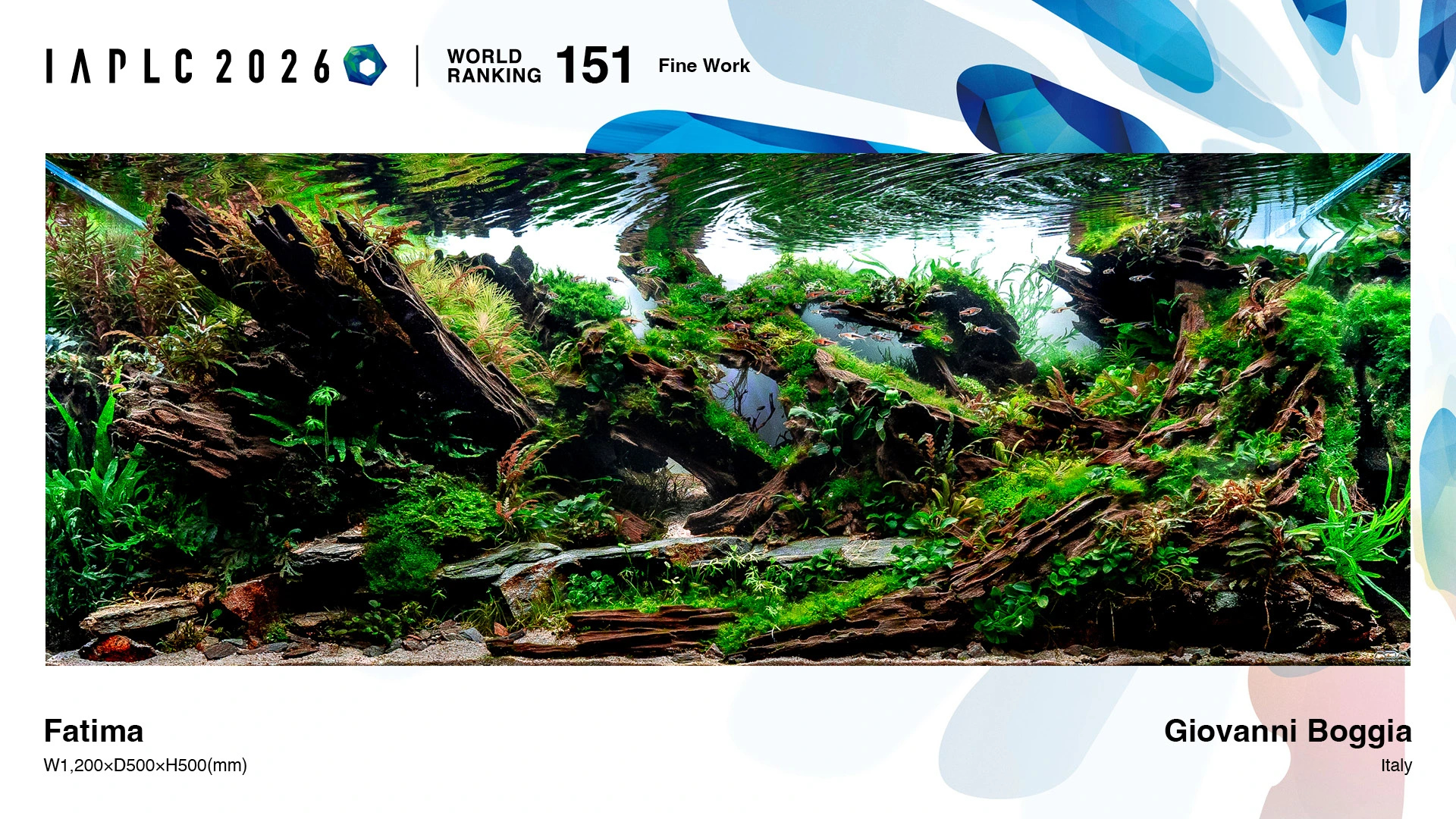
A broken sweep across a broad foreground. Rough dark wood frames the sides and sends lower pieces across the middle. Small patches of pale ground and varied green growth interrupt those horizontal surfaces. Brighter water towards the back separates the heavier near forms from the distance. Warm plant accents gather higher up. The composition makes irregularity useful: breaks in wood and planting stop a broad scene from flattening into one continuous foreground shelf.
Look closer: Look at the gaps between the low pieces of wood.
Discover aquascapers on AquaRank · Back to the selected works
Rank 225 — Fabio Sclocco
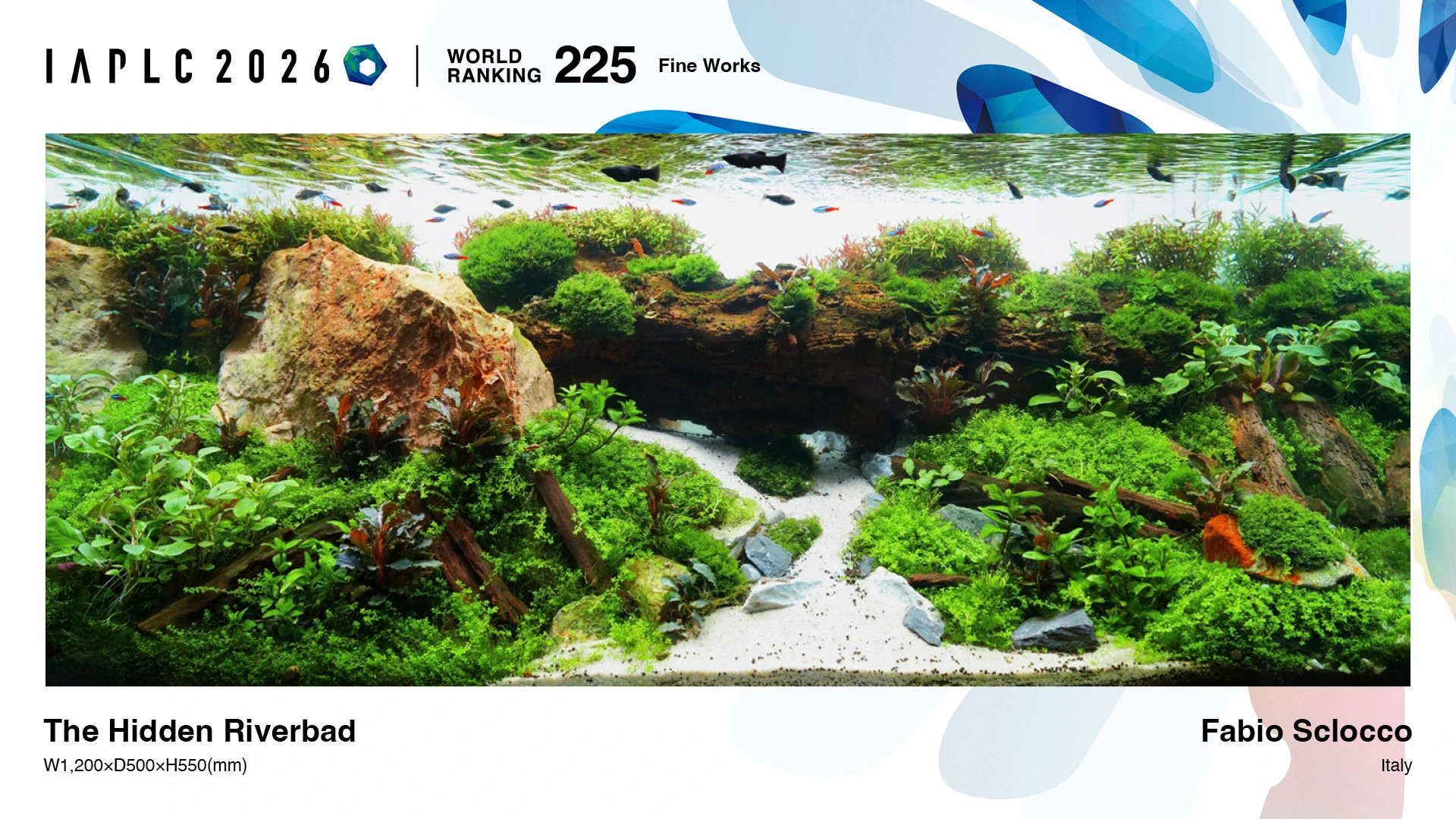
A pale route between planted low structures. A prominent warm-toned stone on the left balances darker wood and planted forms on the right. Pale substrate divides around a small central green mass before continuing towards a low rear crossing. Leafy growth surrounds these structures, while the upper water remains comparatively bright. The aquarium combines soft planted banks and a clear route without building a full-height forest frame around the viewer.
Look closer: Trace the two foreground branches of the pale route.
Discover aquascapers on AquaRank · Back to the selected works
What the comparison reveals
Angelo Roberto Colombo balances planted limbs around a comparatively open middle. Bruno Fiorenza makes a vivid ridge stand out beneath a dark ceiling. Giovanni Boggia breaks a broad near sweep into irregular intervals, while Fabio Sclocco uses a pale route between lower planted forms. The different entrances affect the pace at which the eye moves through each aquarium.
Calm and drama therefore need not be opposing national identities. A readable route may sit within heavy construction; a small colour band may become dramatic because its surrounding frame is dark. The archive’s question about experimentation remains interesting when expressed through those visible choices, rather than as a prediction of competitive success.
A design exercise to take away
Compare the entrance to the foreground with the principal background space. A route becomes more persuasive when both ends have a clear relationship to the frame around them.
All published places at ranks 1–300
| World rank | Published name | Country / area |
|---|---|---|
| 47 | Angelo Roberto Colombo | Italy |
| 101 | Bruno Fiorenza | Italy |
| 151 | Giovanni Boggia | Italy |
| 199 | Cristian Macovei | Italy |
| 225 | Fabio Sclocco | Italy |
Continue through the archive
Revisit the original Italy introduction, then open the IAPLC 2026 gallery to view the selected works at full size and keep browsing beyond them. For a related reading, explore the IAPLC 2026 Top 10 design guide.
Keep exploring with AquaRank Nations. Open Italy’s country overview to move from this season’s photographs to recorded results across available competitions and years. Start with the 2026 IAPLC result, choose an earlier available edition, and follow a creator whose work catches your attention. Country overviews keep competition and edition context visible; they do not combine raw ranks from different contests into one overall score.
Which Italian work would you follow into the country’s earlier competition seasons?


Leave your comments