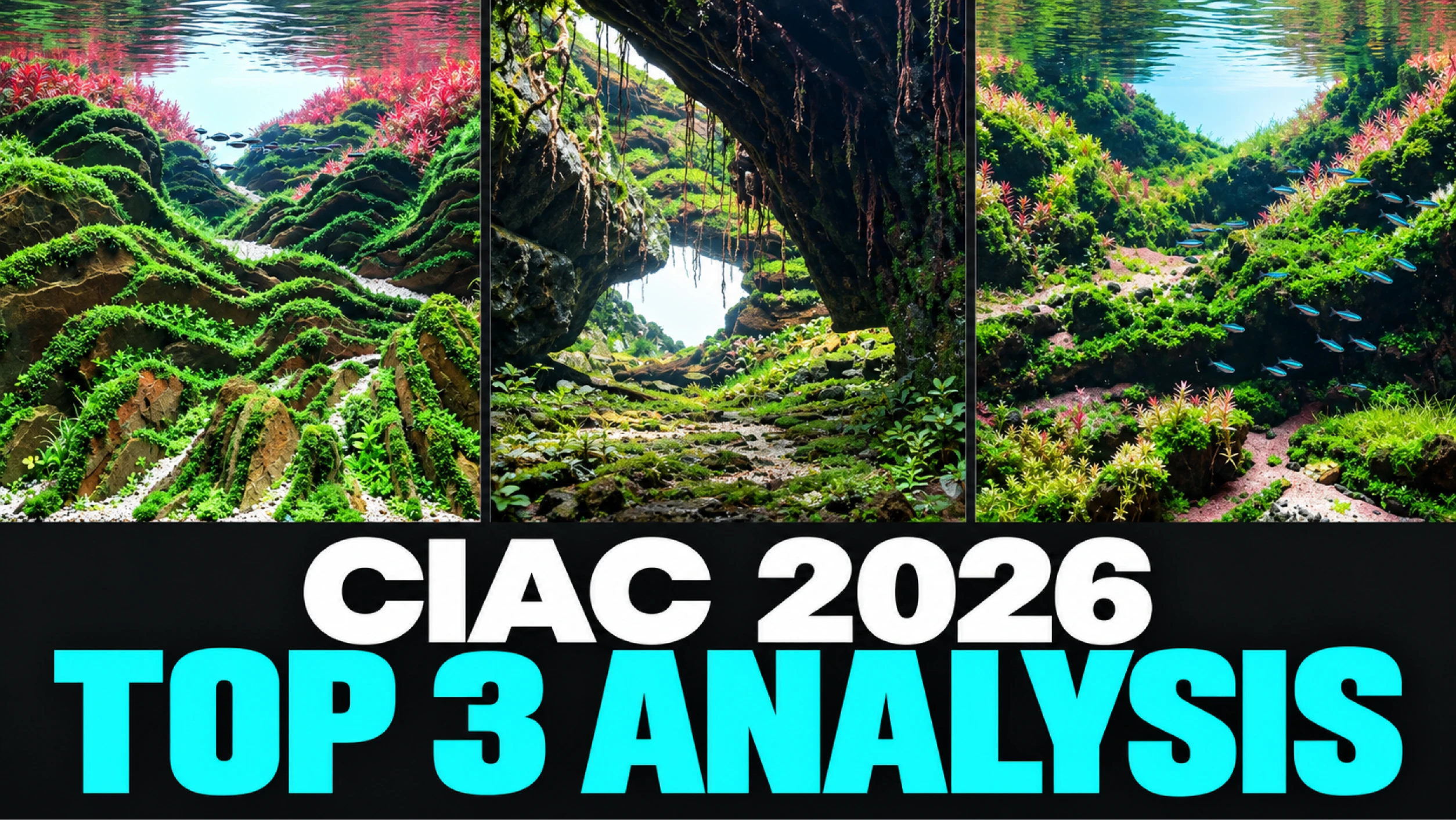
Their common achievement is a strong sense of place. Each photograph establishes where we appear to be standing, what lies in front of us and where the scene continues beyond our immediate view.
In this CIAC 2026 Top 3 analysis, AquaLibs examines composition, depth, planting, light and the visual role of fish. The aim is to understand the choices visible in each work and identify lessons that aquascapers can apply to their own designs.
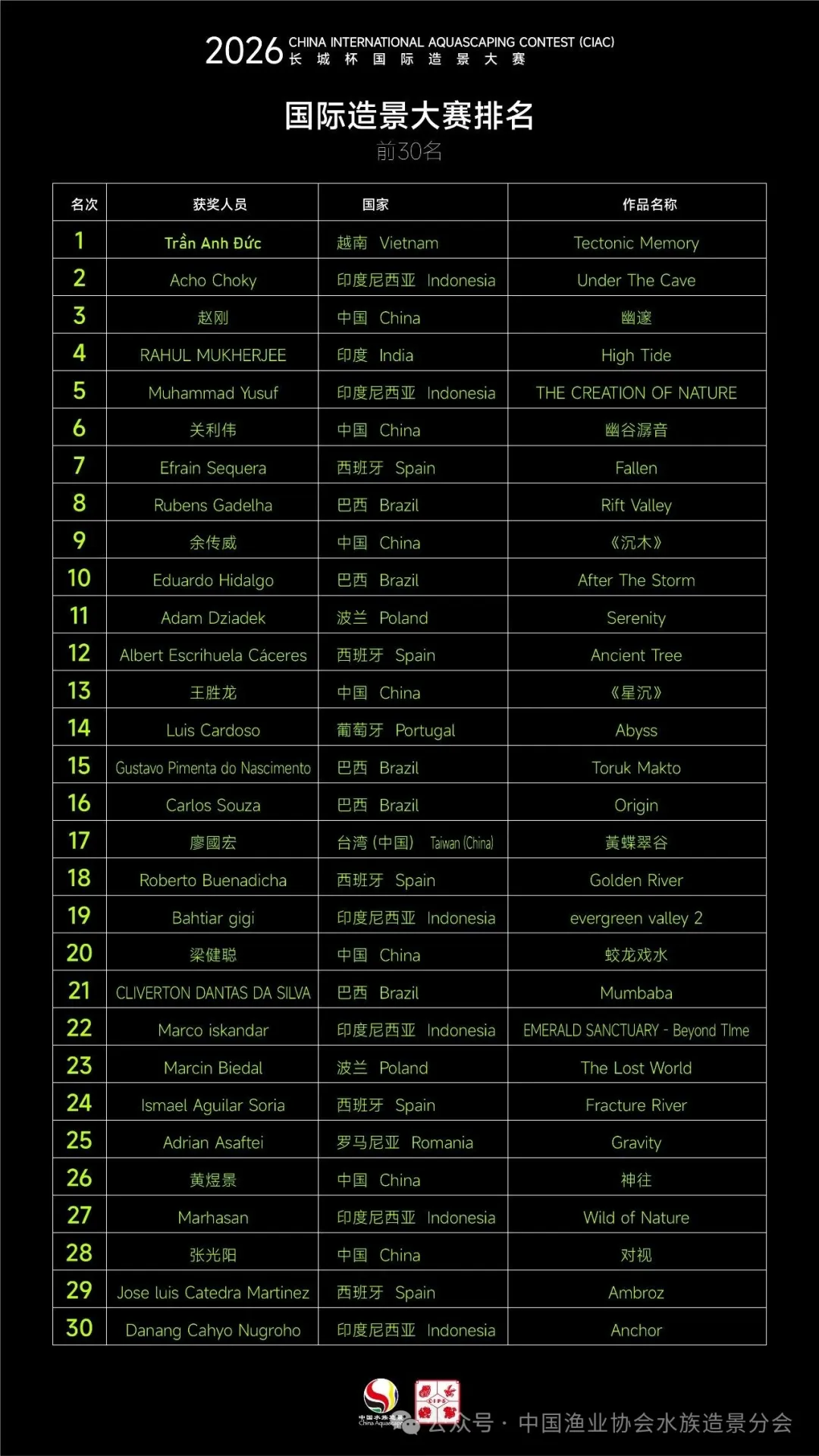
| CIAC 2026 rank | Aquascaper | Country | Work |
|---|---|---|---|
| 1 | Trần Anh Đức | Vietnam | Tectonic Memory |
| 2 | Acho Choky | Indonesia | Under The Cave |
| 3 | Zhao Gang (赵刚) | China | 幽邃 |
The ranks, names and titles follow the published CIAC 2026 Aquascaping Group result cards and Top 30 poster. The analysis below is AquaLibs’ independent interpretation of the photographs, not an official judging commentary. Species, equipment and maintenance routines have not been verified; photographic appearance alone cannot establish long-term aquarium performance.
1. Tectonic Memory: a landscape built through rhythm
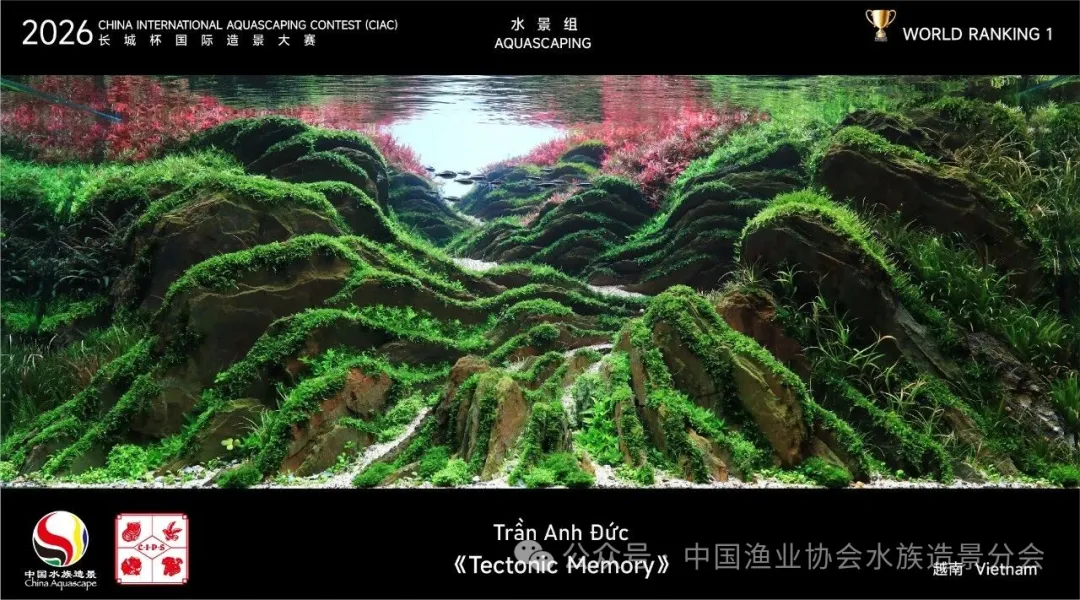
Tectonic Memory — Trần Anh Đức, Vietnam. CIAC 2026 champion. Original contest image card.
Composition: the rocks share a visual language
The first impression is of substantial rock masses with repeated curved contours. Green planting follows many of their edges, making those contours easy to recognise across the aquarium. Rather than reading as separate decorative stones, the forms appear to belong to the same landscape.
The repetition is varied enough to remain interesting. Some ridges rise prominently, others recede behind them, and their slopes change as the eye moves across the scene. The large masses on either side also differ in outline and emphasis. That gives the composition order without turning it into a mechanically mirrored arrangement.
This is the work’s most persuasive quality in our reading: a consistent relationship between the structure of the rocks and the shape of the planting. The title “Tectonic Memory” reinforces that geological impression, although the photograph cannot tell us the author’s full intended narrative.
Depth: the valley is only part of the mechanism
A narrowing central opening provides an obvious route into the distance, but the work’s depth also depends on overlap. Nearer ridges conceal parts of the forms behind them, encouraging the viewer to read several successive layers.
The foreground carries broad, clearly visible rock faces. Farther back, the contours become smaller and more tightly grouped. Together with the brighter rear opening, that change in apparent scale helps suggest distance within the photographed scene.
Look closely at the pale substrate between the foreground forms. It separates neighbouring surfaces and makes their slopes easier to follow. These small gaps matter: filling every interval with vegetation would reduce the legibility of the terrain.
Plants and colour: green reveals the structure
The planting serves several roles. Low green growth marks the ridges; finer upright foliage softens areas around them; and warm pink-red plants near the back provide a colour change above the predominantly green middle and foreground.
Importantly for the composition, the brown rock faces remain visible. Their exposed surfaces provide a textural counterpoint to the green growth. The balance makes the planted aquarium read as a landscape with vegetation growing through it.
A practical lesson is to plan which hardscape surfaces should remain readable after plants develop. For a design using similar contours, growth that obscures every edge could weaken the very pattern that gives the layout its identity. That is a maintenance consideration for this approach, not evidence of a problem in the winning aquarium.
Fish: a small detail that gives the distance life
The visible fish occupy the open water near the central rear area. Their silhouettes contrast with the brighter background, giving the eye a living detail at the point toward which the ridges already lead.
At this scale, they also contribute to the apparent size of the surrounding landforms. Their position strengthens the scene’s depth without competing with the dominant rock rhythm. A still photograph does not establish a school’s normal behaviour, but it shows how fish placement can influence the final composition.
Lesson to carry forward: establish a coherent direction and rhythm in the hardscape, then use plants to clarify that structure. Trần Anh Đức’s championship is a proud result for Vietnam; the design itself offers a valuable study in visual consistency.
2. Under The Cave: depth through enclosure and light
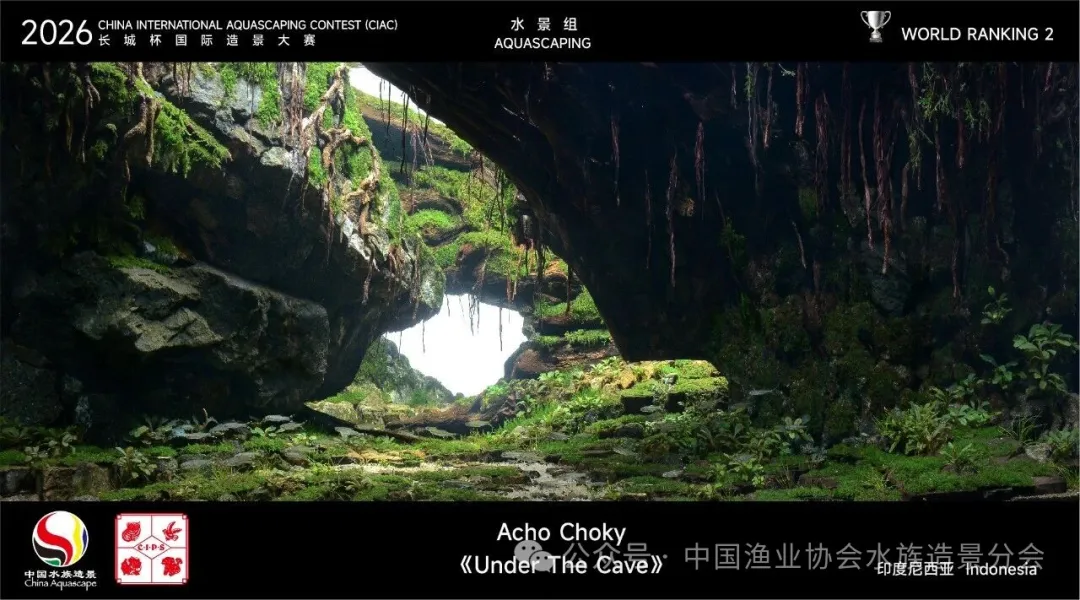
Under The Cave — Acho Choky, Indonesia. CIAC 2026 runner-up. Original contest image card.
Composition: the viewpoint feels deliberately placed
“Under The Cave” establishes an enclosing overhead mass and dark side structures. The viewer appears to be looking from beneath a sheltered interior toward an opening beyond it. That placement creates an immediate relationship between the aquarium and the person studying it.
The canopy is especially effective because it has visual weight. Its broad dark surface makes the lighter space below feel more open. Thin hanging root-like details interrupt the large mass and help connect the overhead structure to the ground beneath it.
The design therefore works at two scales: a simple, easily recognised cave silhouette and a finer network of details that rewards a closer look.
Depth: a destination held inside a frame
The bright opening is the principal visual destination. Dark foreground surfaces frame it, while the textured ground provides intermediate features that carry the eye through the interior.
This differs from the ridge rhythm of “Tectonic Memory.” Here, depth is strongly expressed through occlusion and the contrast between enclosure and release. The large canopy hides part of the space beyond it, making the opening feel like a glimpse into a larger scene.
The contrast also creates a risk inherent in this type of photograph: very dark regions can lose detail, while a bright opening can become visually dominant. In the published image, enough green surfaces and small forms remain visible around the opening to sustain interest in the journey toward it.
Plants and texture: restraint supports the atmosphere
Green growth appears along ledges and surfaces around the cave, while fine hanging elements create a different texture overhead. The planting provides visible signs of life without filling the central opening or making the canopy difficult to read.
Its role is less about a broad display of plant colours and more about the relationship between illuminated vegetation, dark structure and exposed surfaces. Areas of shadow are part of the composition. Leaving those areas visually quieter gives the lighter patches greater impact.
For aquascapers exploring a similar approach, the lesson is to plan for mature growth around the opening. If plants expand into that space, the sense of escape from the cave could become less distinct. The photograph does not reveal the actual lighting distribution or tell us which species would suit those locations.
Fish: a subtler presence in this photograph
Fish are less visually prominent here at the supplied image resolution than in the other podium works. The strongest movement for the eye comes from the canopy edge, hanging details and the progression toward the light.
That observation concerns photographic emphasis. It cannot establish the aquarium’s stocking, the suitability of its swimming space or how its inhabitants behave.
Lesson to carry forward: an opening becomes more powerful when its surrounding frame gives it meaning. Start by designing the silhouette and the space it leaves, then add detail without weakening that relationship.
Acho Choky’s earlier CIAC championship in 2024 adds another reason to follow his work. Explore his AquaRank profile to compare published results and previous aquascapes across seasons.
3. 幽邃: a planted valley with a visible aquatic pulse
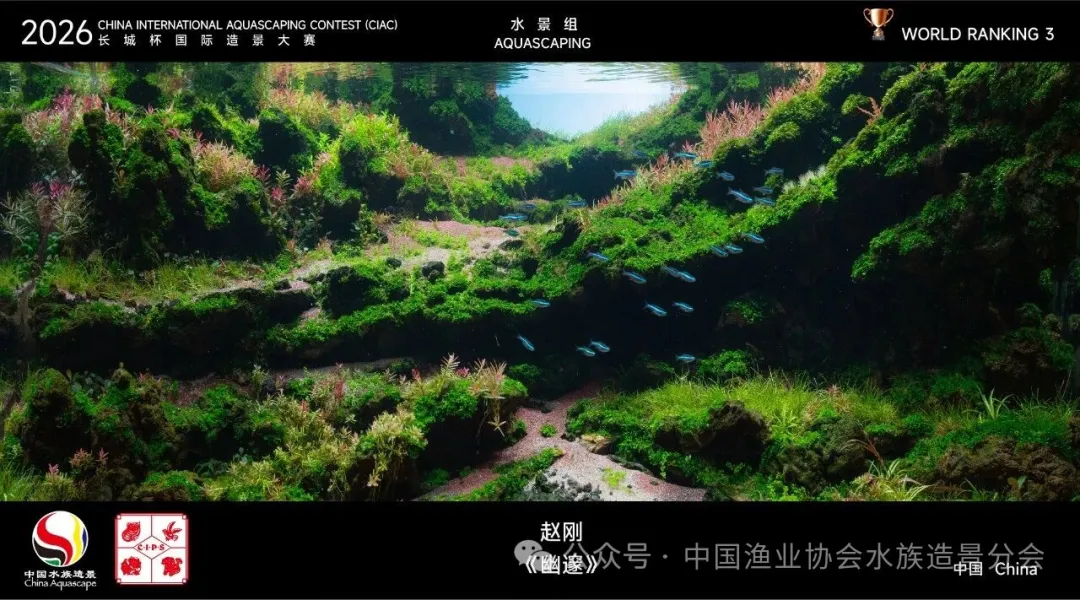
幽邃 — 赵刚, China, listed as Gang Zhao on AquaRank. CIAC 2026 third place. The title is retained in its published Chinese form.
Composition: several layers of vegetation shape the scene
The third-place aquarium presents a richly planted valley. Green-covered forms build the side slopes, while pale substrate openings in the lower centre provide a route for the eye. Warm-coloured upright plants appear at several levels rather than being confined to one distant band.
Compared with “Tectonic Memory,” more of the underlying structure is concealed by growth. The forms remain visible as masses and ledges, but the planting has a larger role in defining their surfaces and boundaries.
This gives the scene an abundant character. It also makes the remaining dark recesses and pale openings especially important: they separate neighbouring areas of vegetation and prevent the picture from reading as one continuous green surface.
Depth: the eye moves between successive openings
The pale foreground route draws attention inward, while overlapping planted forms suggest further space above and behind it. The view does not depend on a completely unobstructed path. Partial concealment creates a sequence of areas to discover.
A brighter opening near the upper rear provides a distant destination. Between it and the foreground, changes in plant height, overlapping ledges and darker pockets establish intermediate layers.
That layering produces a different experience from the cave’s single dramatic frame. The viewer moves through a series of smaller transitions, with planting and fish offering points of interest along the way.
Plants and colour: abundance with useful separation
Green forms the dominant colour field. Pink and reddish planting creates accents across it, and the finer upright growth contrasts with the lower, denser green surfaces.
The important relationship is between those planted areas and the gaps that remain around them. In our reading, the dark recesses help preserve the shape of the planted ledges, while pale substrate gives the lower centre breathing room.
For a similarly lush design, the practical challenge would be retaining those boundaries as growth develops. The lesson is to shape the spaces between plant groups as carefully as the groups themselves. More growth would not automatically make the composition stronger if it erased those separations.
Fish: colour and movement across the middle water
The blue fish are conspicuous against the darker green and black surfaces, particularly through the middle and right-hand part of the photograph. Their distribution gives the valley a visible aquatic presence and adds points of movement between the planted layers.
They are also an important colour accent. The blue bodies contrast with both the dominant green and the warmer plant tones. Their visibility helps the scene register as an inhabited aquarium even as the layout suggests a landscape beyond it.
This is an observation about the published moment, rather than a claim that fish placement was controlled or that the photograph demonstrates natural schooling behaviour.
Lesson to carry forward: use planting, open substrate and dark recesses together to preserve depth. Consider where fish will be visually legible as well as providing an aquarium suitable for their needs.
Visit Gang Zhao’s AquaRank profile to explore his wider competition history, including his CIAC 2025 runner-up result.
Three approaches compared
| Design element | Tectonic Memory | Under The Cave | 幽邃 |
|---|---|---|---|
| Dominant structure | Repeated folded rock contours | Overhead canopy and enclosed sides | Overlapping planted slopes and ledges |
| Main depth mechanism | Scale changes, overlap and a narrowing valley | Dark framing around a bright opening | Successive openings and layers of vegetation |
| Role of plants | Trace contours and soften exposed rock | Add texture while preserving the cave silhouette | Shape much of the visible landscape |
| Use of colour | Broad green field with warm rear planting | Restrained green against strong shadow | Green with repeated warm accents and blue fish |
| Visual role of fish | A focal detail in the brighter distant water | Less prominent at supplied resolution | Conspicuous colour and movement across the middle |
| Lesson for the aquascaper | Make hardscape and planting share a coherent rhythm | Protect the relationship between frame and opening | Preserve separation within abundant planting |
This table summarises AquaLibs’ visual interpretation. It is not a scorecard or an explanation of the judges’ final ordering.
What these works teach beyond the podium
All three designs give the eye a route and a destination, but they use different means to get there. Their depth comes from combinations of overlapping forms, changes in apparent scale, light, shadow and carefully retained openings.
For your next layout, begin by deciding what should be understood at first glance. Identify the main masses and the space between them before choosing how much detail to add. Then ask whether the planting will reinforce that structure as it grows, and whether the photographed fish remain visible within it.
These three works reward both a quick impression and a slower examination. Their first read is clear; closer viewing reveals smaller relationships between surfaces, vegetation and open water. That balance is a useful design ambition well beyond a competition photograph.
To continue exploring, view the CIAC 2026 Top 30 results and original photographs, then discover more aquascapers through AquaRank. AquaRank connects published competition records across seasons; its independent career rankings are separate from the CIAC placements discussed here.
Which of these three aquascapes holds your attention longest—and which detail makes you return to it?
Sources and method: positions and credits are taken from the CIAC 2026 Top 30 poster and original image cards linked above. The photographs are examined at their published resolution. Previous career results are linked to the relevant AquaRank profiles. No unverified judges’ quotations, numerical judging scores or species lists are used.



Leave your comments