With the IAPLC 2026 final reveal approaching on October 10 at 1:00 PM JST, AquaLibs looks back at every Grand Prize winner from 2001 to 2025. Using the historical images in our archive and competition records available through AquaRank, we examine the designs, the countries and areas behind them, and a question that still invites debate: how did the winning aesthetic evolve around the death of Takashi Amano in 2015?
The archive shows clear visual changes. It also shows continuity. Those two observations deserve to be considered together before drawing conclusions about the judges.
Which countries have won the most IAPLC Grand Prizes?
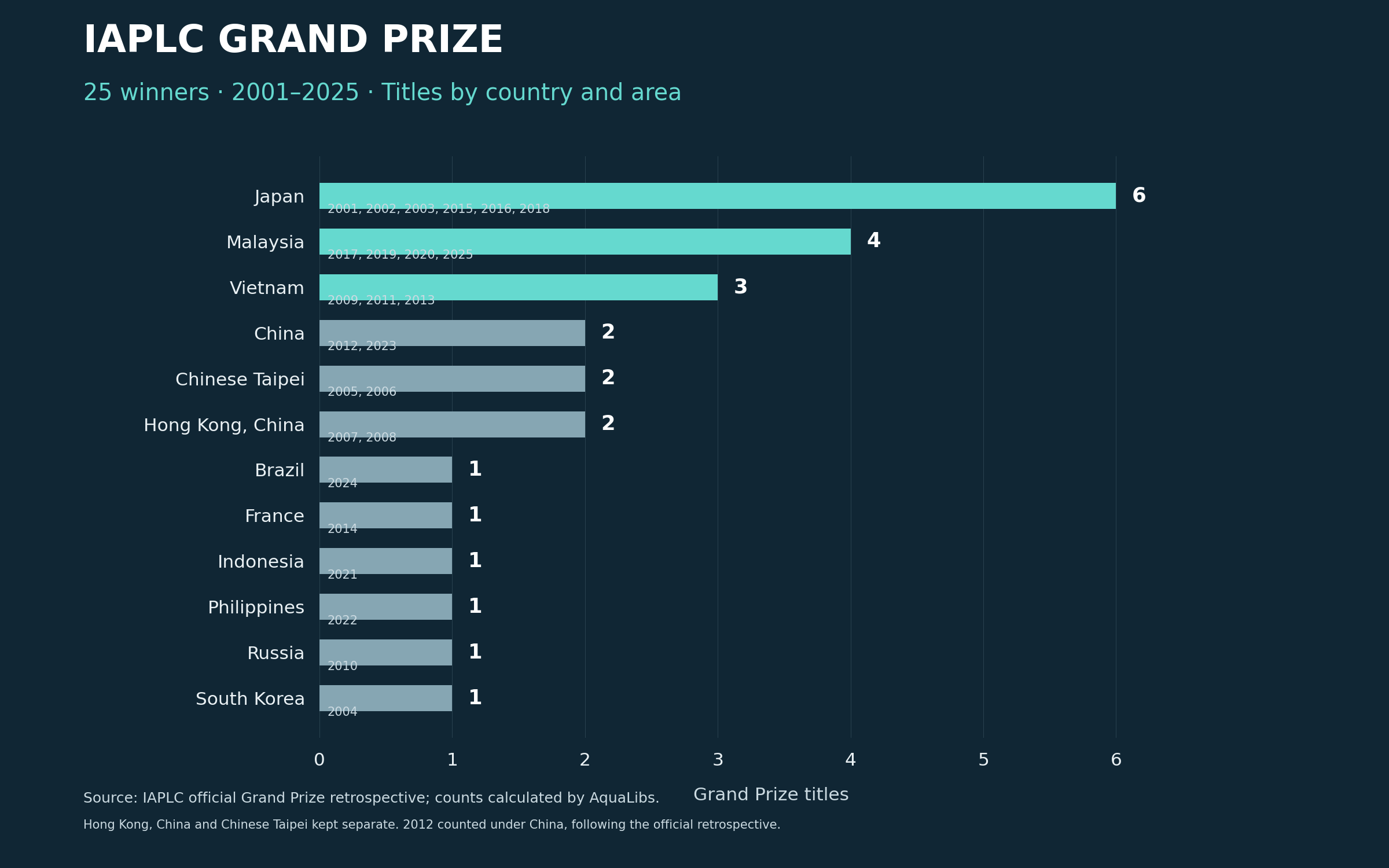
Japan leads with six titles, followed by Malaysia with four and Vietnam with three. Together, these three countries account for 13 of the first 25 Grand Prizes, or 52%.
| Country / area | Titles | Share of titles | Winning years |
|---|---|---|---|
| Japan | 6 | 24% | 2001, 2002, 2003, 2015, 2016, 2018 |
| Malaysia | 4 | 16% | 2017, 2019, 2020, 2025 |
| Vietnam | 3 | 12% | 2009, 2011, 2013 |
| China | 2 | 8% | 2012, 2023 |
| Chinese Taipei | 2 | 8% | 2005, 2006 |
| Hong Kong, China | 2 | 8% | 2007, 2008 |
| Brazil | 1 | 4% | 2024 |
| France | 1 | 4% | 2014 |
| Indonesia | 1 | 4% | 2021 |
| Philippines | 1 | 4% | 2022 |
| Russia | 1 | 4% | 2010 |
| South Korea | 1 | 4% | 2004 |
Counting method: one title per edition, using the country and area labels in the official IAPLC Grand Prize retrospective. “China” consolidates China and People’s Republic of China. Hong Kong, China and Chinese Taipei remain separate contest labels. For 2012, the official retrospective lists Zhang Jianfeng under China, although the archived photograph says Macau. If counted separately as Macau, China, the totals would be China 1 and Macau, China 1; the overall total remains 25.
Japan’s record spans the contest’s first three editions, Takayuki Fukada’s consecutive victories in 2015 and 2016, and Hironori Handa’s win in 2018. Malaysia’s four titles all arrived after 2015: three for Josh Sim and one for Siak Wee Yeo. Vietnam’s three championships, achieved by three different aquascapers in 2009, 2011 and 2013, mark an exceptionally productive five-year period.
The individual record is equally striking. Josh Sim is the only three-time Grand Prize winner in this period. Takayuki Fukada is the only other repeat champion, with two titles. The remaining 20 winning editions belong to 20 different creators.
How the winning aquascapes changed
The following periods describe what can be seen in the winning photographs. They are editorial groupings, not official IAPLC style categories, and individual works frequently combine several approaches.
2001–2004: planted habitats with increasingly deliberate composition
The first winners give plants, fish and water a strong shared presence. Mitsuhiro Machida’s 2001 aquarium is densely planted, yet the angelfish and open water remain essential to its identity. Takehiko Honoki’s 2002 work gives a school of fish generous swimming space above sand and moss-covered wood.
These are sophisticated compositions, not a simple or undeveloped starting point. Their visual emphasis is different from many later winners: plant growth, contrasting foliage and the relationship between fish and shelter carry much of the image. Hidemasa Okuda in 2003 and Lee Jong Ki in 2004 also use foreground routes, sloping masses and tonal contrast to organize depth.
2005–2009: hardscape gains a stronger visual identity
Chen De Quan’s 2005 winner places upright rock formations at the center of the composition. Chen You Lin’s 2006 aquarium uses warm planting around angular stone, showing how colour can establish mood as effectively as a spectacular structure.
The two Hong Kong champions offer another useful contrast: Chow Wai Sun’s 2007 work uses sweeping wood and open space, while Cheng Siu Wai’s 2008 winner reads as a broad, planted mountain panorama. Nguyen Tien Dung’s 2009 composition leads the eye through a pale central channel between wooded banks. There was already more than one winning design vocabulary.
2010–2014: aquariums become immersive landscapes
The clearest expansion toward scenic illusion is visible before 2015. Pavel Bautin’s 2010 woodland uses repeated vertical trunks to establish depth. Long Tran Hoang’s 2011 landscape compresses tree-like silhouettes, layered shelves and a bright opening into the aquarium frame.
Zhang Jianfeng’s 2012 work builds a green canopy around a receding passage; Truong Thinh Ngo’s 2013 winner emphasizes rugged, overlapping rock. Grégoire Wolinski’s 2014 design introduces a particularly imposing sense of enclosure, with rocky openings and a distant illuminated passage.
The practical shift is from arranging attractive objects to controlling how the viewer moves through an imagined space. Repetition, reduced background scale and dark-to-light transitions become central tools. The winning archive therefore does not support the idea that elaborate landscape imagery began only after Amano’s death.
2015–2020: dramatic enclosure, with important exceptions
Fukada’s 2015 and 2016 champions intensify roots, overhangs and openings. Josh Sim’s 2017 forest, his layered 2019 scene, and Siak Wee Yeo’s 2020 canopy explore different forms of immersion. Plants often act as a connective skin over wood and stone, helping a highly constructed framework appear unified.
Yet Hironori Handa’s 2018 winner resists a neat narrative of ever-increasing density. Its open water, sweeping wood and contrasting plant masses feel comparatively airy. That exception matters: the Grand Prize continued to accommodate different relationships between hardscape, planting and empty space.
2021–2025: distinctive structure becomes the central statement
The more recent winners each establish a recognizable compositional idea. Yoyo Prayogi’s 2021 work centers on a monumental rooted tree. Matthew Israel Manes’s 2022 aquascape takes the eye upward through rock terraces. Zhemin Fan’s 2023 forest develops a long, layered route toward a bright opening.
Luis Carlos Galarraga’s 2024 winner uses a sweeping wave-like movement, while Josh Sim’s 2025 aquarium combines a large diagonal structure with river-like textures and hanging roots. These are not interchangeable examples of “more detail.” Their strongest feature is the hierarchy that gives the detail a purpose.
Across the full sequence, the most useful trend is increasing control over spatial storytelling: how a focal structure, a route through the frame, and the relationship between light and shadow make a photographed aquarium feel larger and more coherent.
Before and after Takashi Amano: a turning point, but not a proven change of judging philosophy
ADA announced that Takashi Amano died on August 4, 2015. His passing gives this history an obvious dividing line, but the contest calendar requires care. ADA’s published 2015 schedule placed international judging in early to mid-July and the determination of results in late July—before his death. The public broadcast followed on August 30.
For that reason, this article separates 2001–2014, the transition edition of 2015, and 2016–2025. A result announced after someone’s death is not necessarily a result judged after it.
| Country / area | 2001–2014 14 editions |
2015 Transition |
2016–2025 10 editions |
|---|---|---|---|
| Japan | 3 | 1 | 2 |
| Malaysia | 0 | 0 | 4 |
| Vietnam | 3 | 0 | 0 |
| China | 1 | 0 | 1 |
| Chinese Taipei | 2 | 0 | 0 |
| Hong Kong, China | 2 | 0 | 0 |
| Brazil | 0 | 0 | 1 |
| France | 1 | 0 | 0 |
| Indonesia | 0 | 0 | 1 |
| Philippines | 0 | 0 | 1 |
| Russia | 1 | 0 | 0 |
| South Korea | 1 | 0 | 0 |
| Total | 14 | 1 | 10 |
The geography changes more clearly than the underlying design logic
Malaysia won four of the ten editions from 2016 to 2025, a 40% share. Indonesia, the Philippines and Brazil also recorded their first Grand Prize victories in that period. Japan added two titles. Vietnam, despite three earlier wins, did not win during those ten editions.
This is a shift in the distribution of champions. It is not evidence that judges began favouring particular nationalities: the official IAPLC FAQ states that entrant names and countries are omitted from the material used in both preliminary and world screenings. Country totals describe outcomes, not the information on which judges make their decisions.
2015 provides an unusually strong test of the “post-Amano” hypothesis
Fukada’s 2015 work already contains the dense roots, theatrical shadows and carefully directed perspective often associated with later competition aquascapes. More significantly, the 2015 winner’s account and judging comments preserved in the AquaLibs archive record Amano choosing that work as his Best Aquarium.
In those comments, Amano valued the distinctive wood framework, the perspective produced by composition and planting, and the apparent comfort of the fish. That combination challenges a simple opposition between a restrained “Amano style” and a dramatic style introduced by later judges. An intricate forest could already be appreciated within his interpretation of a convincing aquarium.
Fukada’s consecutive titles also make 2015–2016 a case of continuity. The second work develops a more cavernous setting, but both use enclosure, planted textures and a luminous opening. The archive suggests an existing language being extended across the historical boundary.
Could the balance of judging preferences still have changed?
It is a reasonable hypothesis. Losing a prominent judge can change the balance of individual preferences, and later generations of aquascapers can respond to the works that receive recognition. However, those mechanisms are possibilities, not findings established by these 25 photographs.
The published IAPLC judging framework still gives substantial weight to fish habitat, alongside maintenance, technical execution, originality, natural atmosphere and composition. The secondary rubric allocates up to 50 points to habitat and up to 10 points to each of five other criteria; these are not percentages of the entire final result, which also incorporates other screening scores. Meanwhile, the official FAQ explicitly describes continuity with Amano’s founding approach of evaluating different layout styles together.
Establishing an actual change in judging preference would require more than the annual winner: dated judging rules, panel membership, individual selections and scores, and a consistently coded sample of the wider field before and after 2015. A different-looking champion might reflect a changing pool of entries, improved execution or a particularly original work rather than a new scoring policy.
Our editorial reading is that IAPLC’s winning visual language broadened across both eras, while dramatic landscape construction was already established during Amano’s lifetime. His death is a significant historical boundary. The available evidence does not establish it as the cause of a stylistic break.
All IAPLC Grand Prize winners, 2001–2025
Each photograph below is the historical winning work, not a generated illustration. Year, creator and country are cross-checked against the official Grand Prize retrospective. Titles follow that retrospective’s English wording; romanized names and titles may differ slightly elsewhere in the archive. Follow an available AquaRank profile to explore the creator’s wider record, or open the edition archive to see the surrounding field.
2001 — Mitsuhiro Machida / Japan

Dense greenery and hanging roots surround an open pocket of water, with angelfish giving the composition an unmistakably aquatic identity. The emphasis is on a living scene rather than a distant miniature landscape.
2002 — Takehiko Honoki / Japan

Moss-covered wood rises above pale sand and loose, grass-like planting. Broad swimming space makes the fish central to the photograph, while the hardscape supplies direction without enclosing the entire view.
2003 — Hidemasa Okuda / Japan

Branching wood and layered vegetation create a shaded, intimate scene. A pale foreground route and brighter upper planting already demonstrate how contrasting tones can suggest depth inside a compact frame.
2004 — Lee Jong Ki / South Korea

Sloping green plant masses frame upright stone and an open channel. The composition bridges luxuriant planting and a more landscape-like arrangement of hardscape, with a school of fish marking the water column.
2005 — Chen De Quan / Chinese Taipei

Tall, narrow rock formations rise from a low green foreground. Hardscape becomes the principal subject, with vegetation softening the structures rather than competing with them for attention.
2006 — Chen You Lin / Chinese Taipei

Warm red and orange planting surrounds sharply textured stones. The contrast between soft plant masses and angular rock gives this winner a distinct seasonal mood without relying on an elaborate forest scene.
2007 — Chow Wai Sun / Hong Kong, China

A dark, branching wood mass stretches diagonally across an open foreground. Negative space and a visible school of fish balance its weight, giving the image a less enclosed character than many later winners.
2008 — Cheng Siu Wai / Hong Kong, China

Repeated green-covered rock forms build a broad, mountain-like panorama. Differences in size and height produce distance across the frame, showing that landscape abstraction was well established before 2015.
2009 — Nguyen Tien Dung / Vietnam

Branching wood and dense banks of greenery surround a pale, narrowing channel. The foreground is spacious, while the route into the background makes perspective a clear organizing device.
2010 — Pavel Bautin / Russia

Repeated vertical trunks create the impression of a submerged woodland. Their spacing, scale and progressively softer background establish a distinctly immersive forest composition five years before Amano’s death.
2011 — Long Tran Hoang / Vietnam

Layered rock shelves and compact green growth form tree-like silhouettes around a luminous opening. The carefully controlled scale encourages the viewer to read the aquarium as a much larger landscape.
2012 — Zhang Jianfeng / China

Rounded green canopies and branching forms frame a pale central passage. Repeated shapes carry the gaze into the distance. The archive image labels the area Macau; the official retrospective lists the winner under China.
2013 — Truong Thinh Ngo / Vietnam

Mossy rock masses overlap across a low, rugged panorama. Texture, small-scale planting and gaps between the structures create depth without the strongly enclosed ceiling seen in several later champions.
2014 — Grégoire Wolinski / France

Large rocky forms create side openings and a bright route toward the background. The sense of entering a cavernous landscape is already explicit, providing a strong counterexample to a purely post-2015 origin for dramatic scenery.
2015 — Takayuki Fukada / Japan

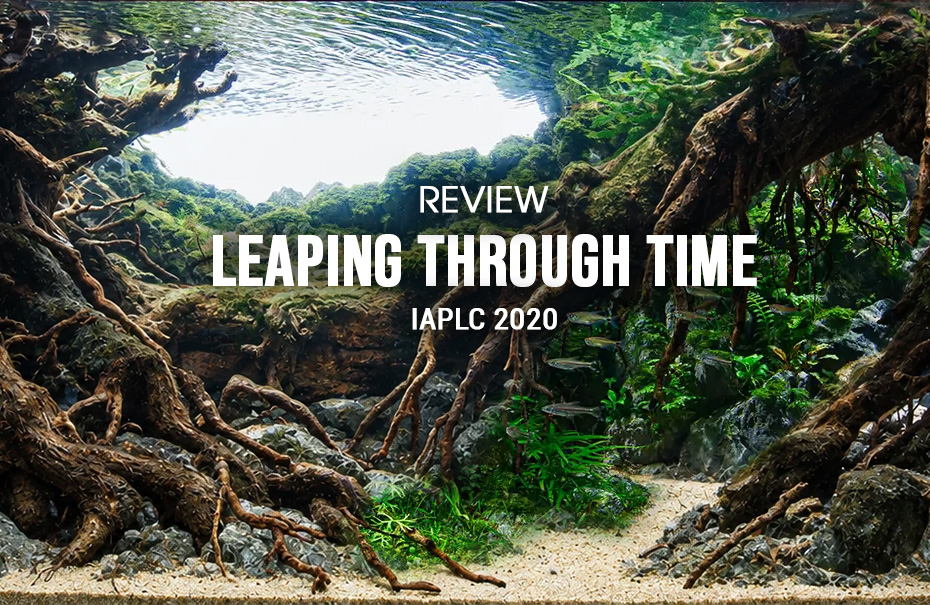
Interlocking roots, trunks and hanging growth surround a pale central passage. Deep shadows and a bright opening pull the viewer into the forest. This is the transition-year winner, not evidence of judging after Amano’s death.
2016 — Takayuki Fukada / Japan
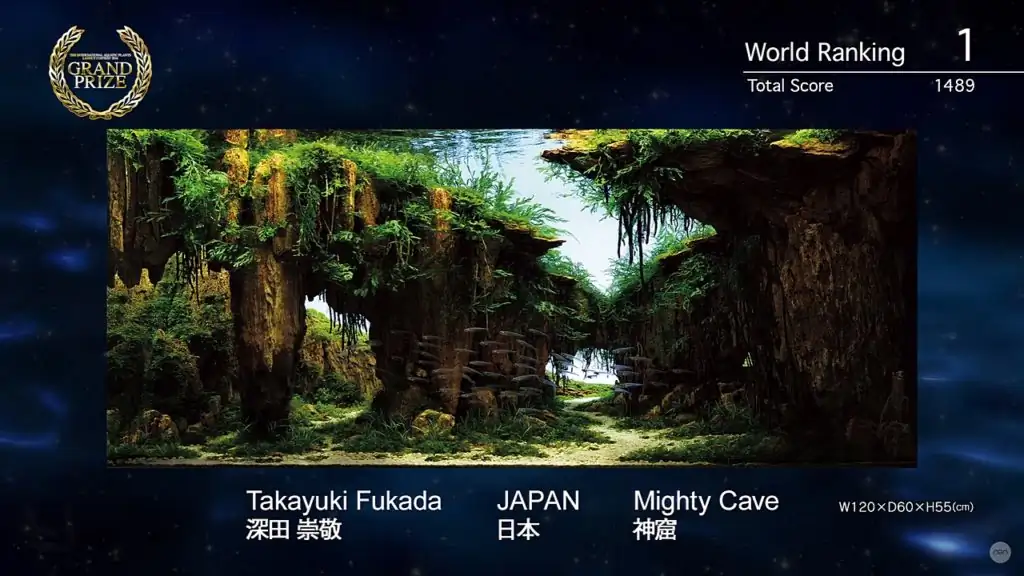
Overhanging rock and vegetation create a cavern-like interior with a bright exit. Compared with the previous winner, enclosure and vertical relief become more pronounced, while planting still softens the hardscape.
2017 — Josh Sim / Malaysia

Large roots sweep through a dense green forest, with overlapping trunks producing several planes of depth. The central opening offers relief, while fine planting ties the dramatic structure into a coherent aquatic scene.
2018 — Hironori Handa / Japan

Open water, a green carpet and sweeping wood balance warmer plant tones. Its airy composition is an important reminder that a highly detailed forest or cave was never the only route to the Grand Prize.
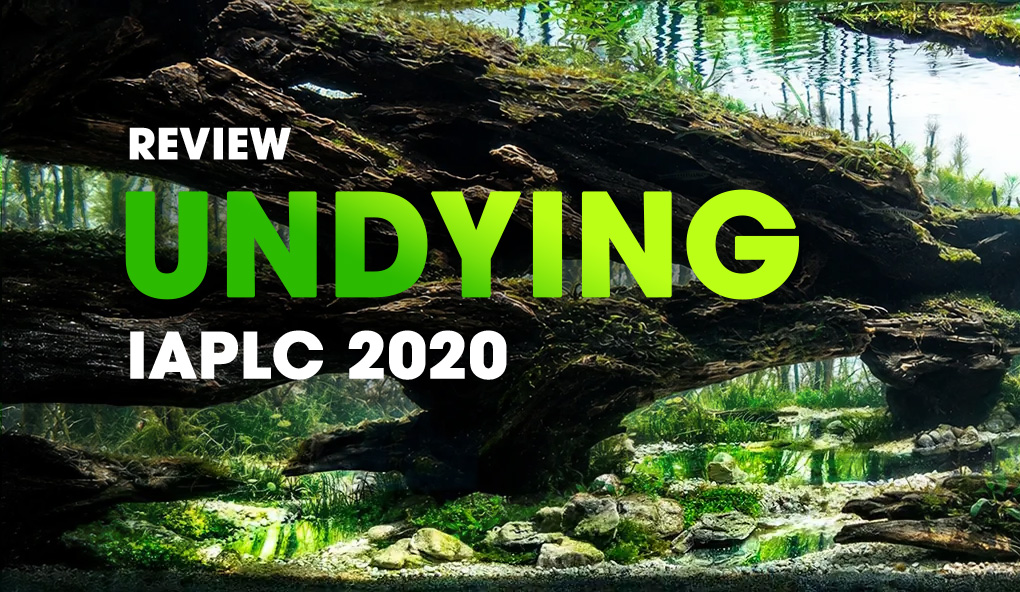
2019 — Josh Sim / Malaysia

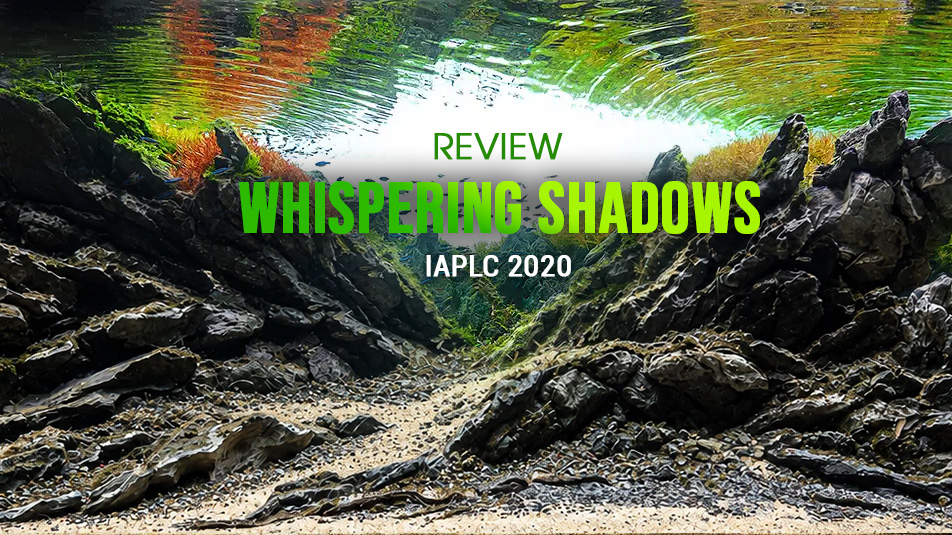
Broad, layered wood forms extend above a stony foreground, with reflections adding height and complexity. The scene reads as a waterside environment as well as a carefully organized photographic composition.
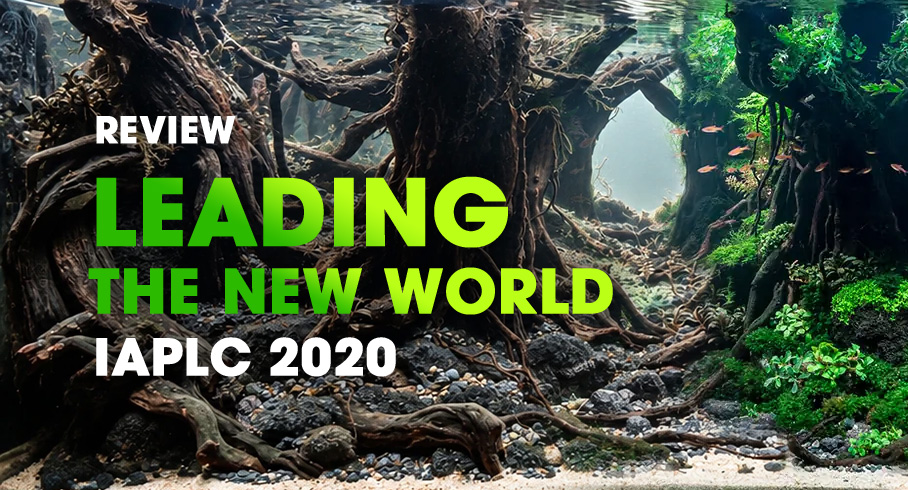
2020 — Siak Wee Yeo / Malaysia

A heavy canopy, hanging growth and a bright central opening create a powerful feeling of enclosure. Dark foreground structures and smaller background details intensify the impression of looking deep into a forest.
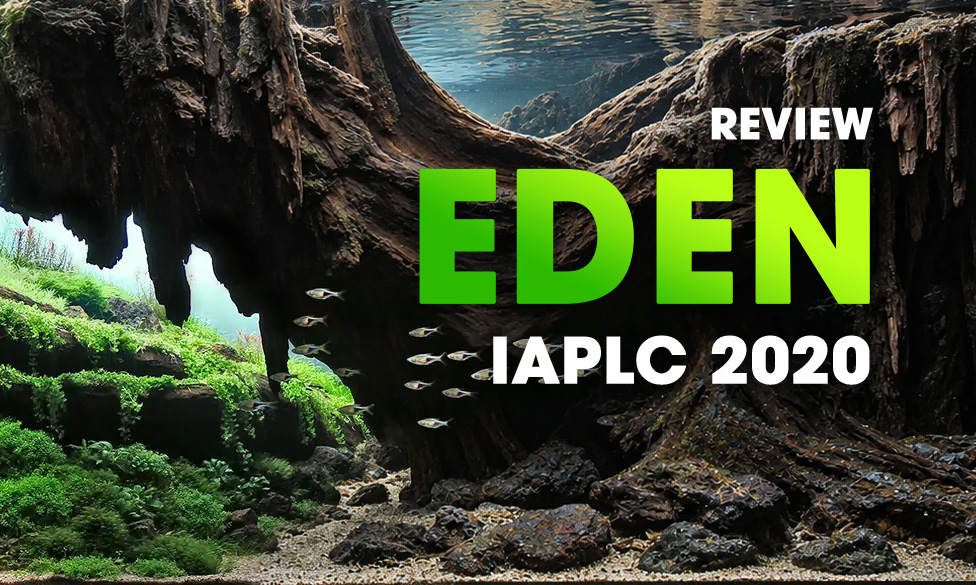
2021 — Yoyo Prayogi / Indonesia

A monumental root structure anchors the foreground, surrounded by smaller trunks and dense greenery. The design gives a single dominant subject a strong identity while using background repetition to expand its apparent scale.
2022 — Matthew Israel Manes / Philippines
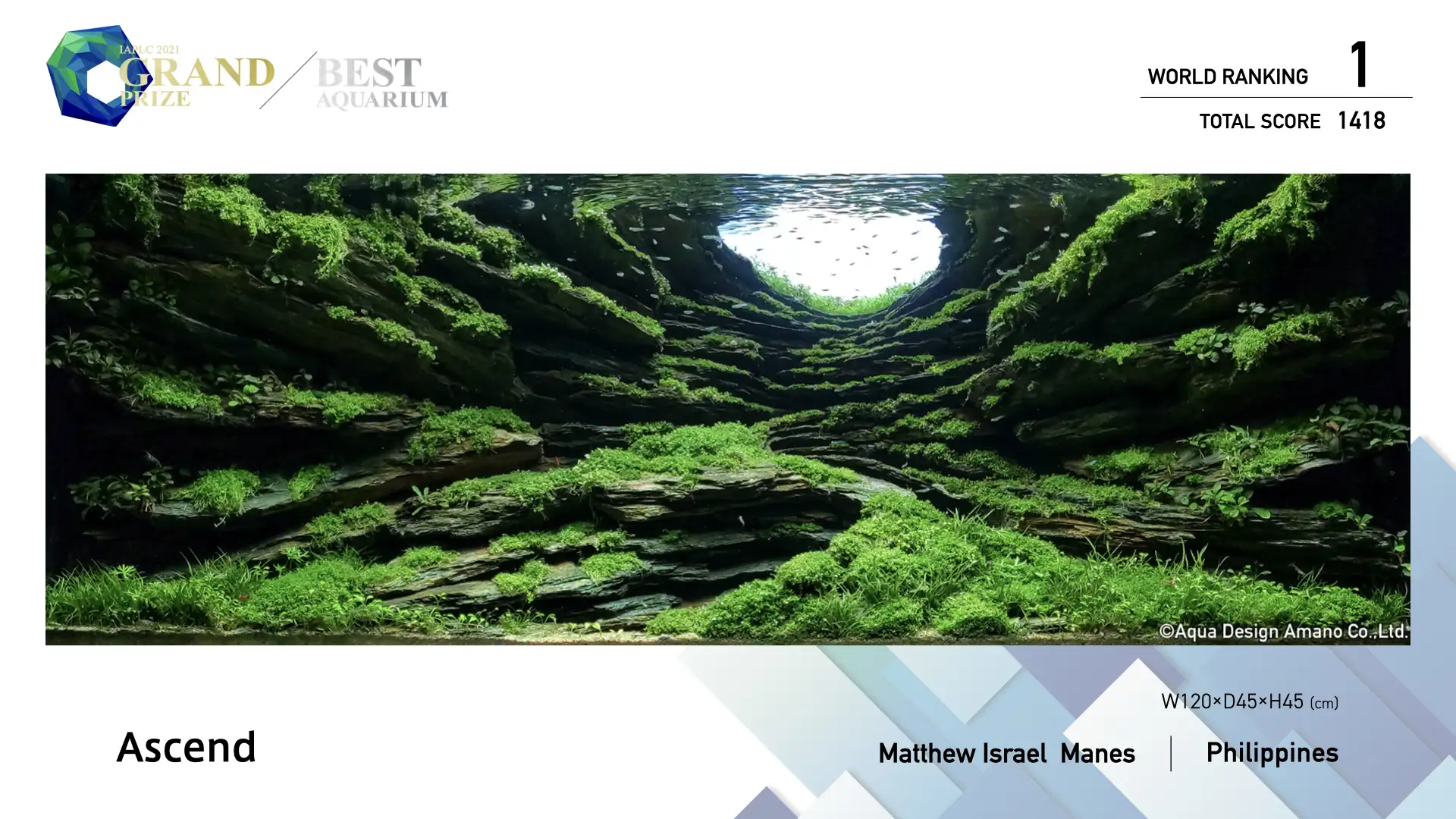
Stepped rock ledges recede toward a bright upper opening. The eye travels upward through repeated layers, making the direction of depth a defining feature rather than relying on a single foreground-to-background path.
2023 — Zhemin Fan / China

Long root forms lead through a densely planted woodland toward a round, bright opening. The contrast between rough foreground textures and smaller background elements strengthens the sense of a continuous environment.
2024 — Luis Carlos Galarraga / Brazil

A sweeping, plant-covered wood structure creates a wave-like gesture across open water. Surface texture and a clear directional flow supply drama without repeating the straight-on forest corridor of several earlier winners.
2025 — Josh Sim / Malaysia

A large diagonal wood form crosses a richly textured river-like scene. Hanging roots, rocky foreground details and a bright upper opening combine an immersive composition with visible cues of an underwater habitat.
Which country could win the IAPLC 2026 Grand Prize?
Historical titles provide context, and the 2026 nominees provide a current shortlist. Neither reveals the quality of the unreleased layouts. The following is an editorial watchlist, not a probability model or an assessment of photographs that have not yet been published.
Our lead pick: Malaysia
Malaysia has the strongest recent Grand Prize record: four wins across the last ten completed editions. Both Josh Sim, the defending champion and a three-time winner, and 2020 champion Siak Wee Yeo appear in the 2026 nominees. Malaysia’s eight nominated entrants provide a compelling combination of recent success and proven experience. On the public evidence available, Malaysia is our editorial pick.
The strongest challengers: Japan and China
Japan has six historical titles and the largest 2026 nominee group, with 68 names. Former champions Takayuki Fukada and Hironori Handa are nominated, as are 2025 medalists Katsuki Tanaka and Hidekazu Tsukiji. That breadth makes Japan a major contender even though its latest Grand Prize was in 2018.
China has 41 nominees. Gang Zhao’s runner-up finish in 2025 gives it a particularly relevant recent benchmark, while the country’s latest Grand Prize came in 2023. The record supports close attention, but a previous podium place cannot tell us how a new work will be judged.
The return-to-the-top storyline: Vietnam
Vietnam has 29 nominees and three historical Grand Prizes. Former champion Long Tran Hoang is among the nominated names. Its previous titles were spread across three different creators, making a fourth win a community milestone rather than simply a repeat of one individual’s achievement. Vietnam is one of the most compelling countries to follow on reveal day.
The recent breakthrough to watch: Brazil
Brazil’s first Grand Prize arrived in 2024 through Luis Carlos Galarraga, who is nominated again in 2026. With nine nominees, Brazil offers a strong recent champion’s storyline beyond the countries leading the all-time totals.
A first-time winning country remains entirely possible. Indonesia in 2021, the Philippines in 2022 and Brazil in 2024 demonstrate how quickly the list can expand. Nominee counts are not winning probabilities, and no country is owed a title. The award goes to one work.
Compare the 2026 TOP 300 by country with the AquaRank historical record, then make your own choice below.
Your prediction: which country or area will win?
Which country or area will take the IAPLC 2026 Grand Prize? Choose from the countries and areas represented in this year’s TOP 300. Vote for the country you expect to win, then tell us in the comments what makes it your pick.
Loading the reader poll…
This is an independent AquaLibs community prediction poll, not an official IAPLC vote. It does not affect judging. Voting closes when the results livestream begins: October 10, 2026, at 1:00 PM JST / 04:00 UTC / 11:00 AM Vietnam time. It allows one vote per signed-in account or browser cookie; results reflect participating readers, not a representative survey.
After the reveal, we will compare the readers’ choice with the winning work and add the 2026 champion to this historical overview. Until then, the archive offers something worth sharing: twenty-five different ways to turn a glass aquarium into a memorable world.
Sources and methodology
Winner identities, titles and the country-count convention were checked against the official IAPLC Grand Prize retrospective. Photographs were selected from the AquaLibs historical edition galleries and AquaRank profiles, linked individually above. Visual descriptions are AquaLibs editorial observations from those photographs; style labels are not official categories. A single image cannot establish a layout’s maintenance history or ecological performance.
- ADA: The loss of Takashi Amano, August 8, 2015.
- ADA: Published IAPLC 2015 judging schedule, June 17, 2015.
- AquaLibs archive: Fukada’s 2015 account and judging comments.
- IAPLC: Published judging criteria.
- IAPLC: FAQ on screening, anonymity and contest philosophy.
- ADA: 2026 nominees and final reveal announcement.
- Official IAPLC 2026 TOP 300 nominee list, counted by AquaLibs.
- Official IAPLC 2025 results, used for recent contender context.
Research checked October 4, 2026. AquaRank is an independent historical ranking built from published competition results; it is not the official IAPLC ranking.


Leave your comments