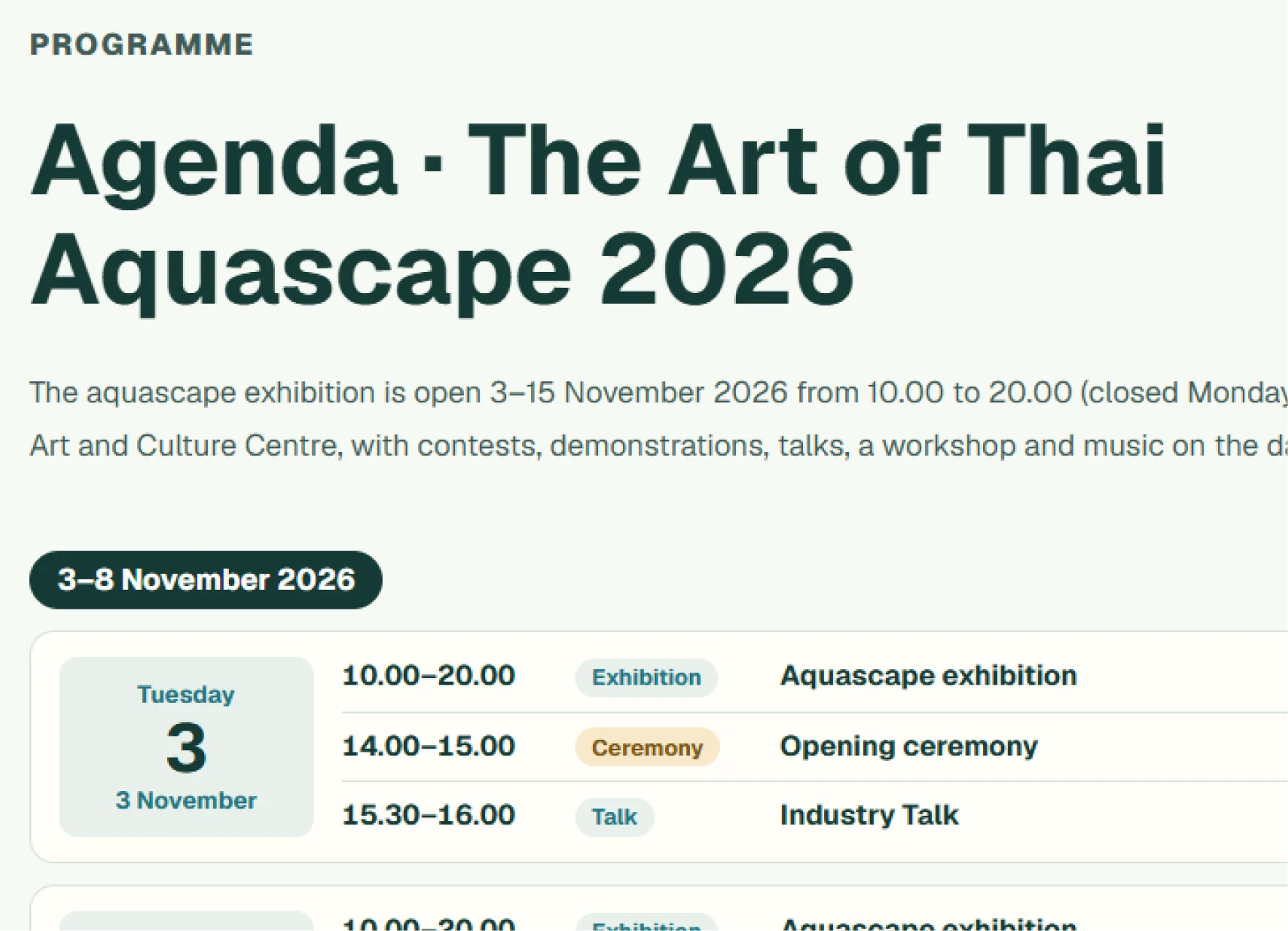
A festival programme becomes a tank-building checklist
The event separates aquascaping into several stages: making the layout, presenting it to an audience, discussing the decisions behind it and recording the result through photography. Tank builders can use the same sequence at home.
Begin with a clear concept before adding hardscape or plants. Decide what visual impression the aquarium should create, then select materials and species that support it. Once the layout is established, assess it from the viewing distance at which it will normally be seen. Finally, photograph the tank only after checking composition, lighting and distracting equipment.
The exhibition, contests, demonstrations and talks listed in the agenda reflect different parts of this process. Together, they encourage aquascapers to treat the aquarium as both a living system and a finished visual composition.
What professional and newcomer contests can teach
The programme includes a professional aquascaping contest centred on the 12 Zodiac and a Freshy Aquascape Contest 2026 for newcomers. The presence of both formats is a reminder that good aquascaping is not limited to experienced competitors.
For a beginner, a contest-style approach can make a project easier to manage. Set a defined brief, establish a deadline and decide which elements matter most: the outline of the hardscape, the balance of planted and open areas, or the sense of depth. Avoid changing every part of the design at once. Instead, make one adjustment, observe the result and keep notes.
A professional category can also be viewed as a study exercise rather than a standard to imitate. Look for repeatable decisions—such as how a focal area is framed or how negative space is preserved—and adapt those principles to the size, equipment and maintenance routine of your own aquarium.
Demonstrations reveal the value of decisions made in sequence
The agenda lists an aquascaping demonstration by Josh Sim on November 6, followed by a newcomer contest mentored by Josh Sim and Denis Wong on November 7. Watching a layout develop can be more instructive than seeing only a finished display because it exposes the order in which choices are made.
At home, work from structure to detail. Position the main stones or wood first, then check their relationship from the front and sides of the tank. Add supporting pieces only when they strengthen the composition. Place plants according to their eventual scale and maintenance needs, leaving room for growth and access to the glass.
This sequence also limits unnecessary rework. If the hardscape is changed after planting, plants may be disturbed and the water may become cloudy. A deliberate start can make later maintenance simpler.
Talks and mentoring turn taste into practical feedback
Industry talks, a discussion featuring Josh Sim and Nikorn Saetang, and a special talk by Denis Wong are part of the listed programme. The Freshy contest is also described as being mentored by Josh Sim and Denis Wong. These elements point to an important habit for hobbyists: explain a design choice clearly, then invite specific feedback.
Instead of asking whether a tank looks good, ask focused questions. Is the focal point obvious? Does the hardscape lead the eye in a consistent direction? Is there enough open space? Do the plants support the intended scale? Specific questions produce feedback that can be acted on.
Before seeking advice, write down the aquarium’s concept and constraints. A recommendation that suits a large contest display may not suit a small home tank, a low-tech setup or a schedule with limited maintenance time.
The photography workshop offers a final presentation lesson
The programme includes a free, limited-seat aquascape photography workshop with Thaweechai Jaowattana on November 10. Its inclusion highlights how much of an aquascape’s impression depends on presentation after the construction work is complete.
For a home photograph, clean the glass and remove temporary tools, hoses and other distractions. Choose a viewpoint that shows the intended composition rather than an accidental reflection. Keep the camera level when possible, and check that the brightest area does not pull attention away from the focal point.
Take several images after the aquarium has settled, changing one variable at a time. Compare framing, reflections and light balance rather than relying on a single quick snapshot. Photography should document the aquarium honestly; it should not replace healthy plant growth, clean water or a stable maintenance routine.







Leave your comments