
Follow the photographs into the wider country story with the new AquaRank Nations: explore Indonesia’s IAPLC 2026 results and the creators behind them.
This is part of AquaLibs’ IAPLC 2026 Country Studies, returning to our archived Indonesia introduction through this season’s photographs. The archive is historical commentary; the new observations are AquaLibs’ independent visual analysis, separate from official judging. The 4 selected works form an editorial comparison, not a census of national styles.
The 2026 result in context
| Published ranking range | Indonesia places |
|---|---|
| Ranks 1–7 | 0 |
| Ranks 1–27 | 0 |
| Ranks 1–100 | 1 |
| Ranks 1–300 | 4 |
Counts are calculated from the official final ranking, using the country-and-area label Indonesia. They count published places, not total submissions or participants. Rank 61 is vacant, so the global ranks 1–300 contain 299 published names.
From individual aquariums to the national view
Indonesia has four published places in ranks 1–300, but its fifth contributing Nations result is rank 324. This is a particularly useful reason to open the national view: the editorial photo cutoff should not become the boundary of a country’s competition story. Study the four wooded environments here, then continue to the full published results and available creator histories.
| AquaRank Nations · IAPLC 2026 | Indonesia |
|---|---|
| AquaRank national position | #16 |
| Average of five contributing overall ranks | 185.4 |
| Contributing individual ranks | #90, #129, #178, #206, #324 |
| Published country results in the full edition | 16 |
These are AquaRank’s calculated national standings, not official IAPLC national awards. The average uses the five lowest overall ranks from five confirmed aquascapers; a lower average is better. The 2026 edition is marked as complete on Nations. This full-ranking view is broader than the Top 300 photo selection used in this article. Figures were checked on 16 October 2026.
Explore Indonesia at IAPLC 2026 on AquaRank Nations →
Open the contributing five, follow available artwork and creator profiles, then use the edition selector or Indonesia’s IAPLC history to explore other available seasons. Use the IAPLC 2026 nations comparison to see the same method applied across countries and regions.
Inspired by Josh Sim’s IAPLC Nations Challenge. Read the Nations methodology for coverage and ranking rules. The average describes results; it does not measure a design style or explain a judge’s decision.
Follow the country journey
Explore Indonesia through the years below. Switch between nation position and average rank, then open an edition or its contributing aquascapers to continue the journey.
Indonesia at IAPLC
Loading country history…
Returning to the archive
The archived Indonesia introduction, published in 2021 and attributed to IAPLC Nations Challenge, strongly associated the country with forest scenes and elaborate wooden craftsmanship. It also offered opinions about construction density and plant development. A photograph alone cannot establish how long a layout matured or how it is maintained, so the 2026 comparison concentrates on visible frame, planting texture, water and fish.
The photographs to study
| World rank | Creator | A detail to follow |
|---|---|---|
| #90 | Robi Chen | A surface canopy above a conspicuous fish group |
| #129 | Danang Cahyo Nugroho | A dominant trunk anchors a sloping woodland |
| #178 | Acho Choky | A forest defined by upright rhythm |
| #206 | Aditia Eko Saputro | Wood and rock leave a central water interval |
Rank 90 — Robi Chen

A surface canopy above a conspicuous fish group. Warm surface leaves rise above wood and green growth arranged across the middle. A group of blue-marked fish is highly visible in front of the dark timber, giving the water a strong visual role. Pale substrate remains exposed in the foreground. The canopy, branches and fish create distinct levels of interest, so the scene can be read as an aquarium with occupied water as well as a planted landscape.
Look closer: Look at the fish group’s background before examining the canopy.
Discover aquascapers on AquaRank · Back to the selected works
Rank 129 — Danang Cahyo Nugroho

A dominant trunk anchors a sloping woodland. A large dark trunk occupies the near middle, while planted branches and higher greenery climb towards a warmer, brighter background. Smaller low leaves and fine growth connect the trunk to the foreground. The fish are a quieter component at this viewing size. The strongest spatial relationship is between the heavy near anchor and the softer ascending ground beyond it, which makes the scene feel deeper than its front silhouette alone.
Look closer: Follow the rising planted ground around the trunk rather than stopping at it.
Explore Danang Cahyo Nugroho’s recorded work on AquaRank · Back to the selected works
Rank 178 — Acho Choky
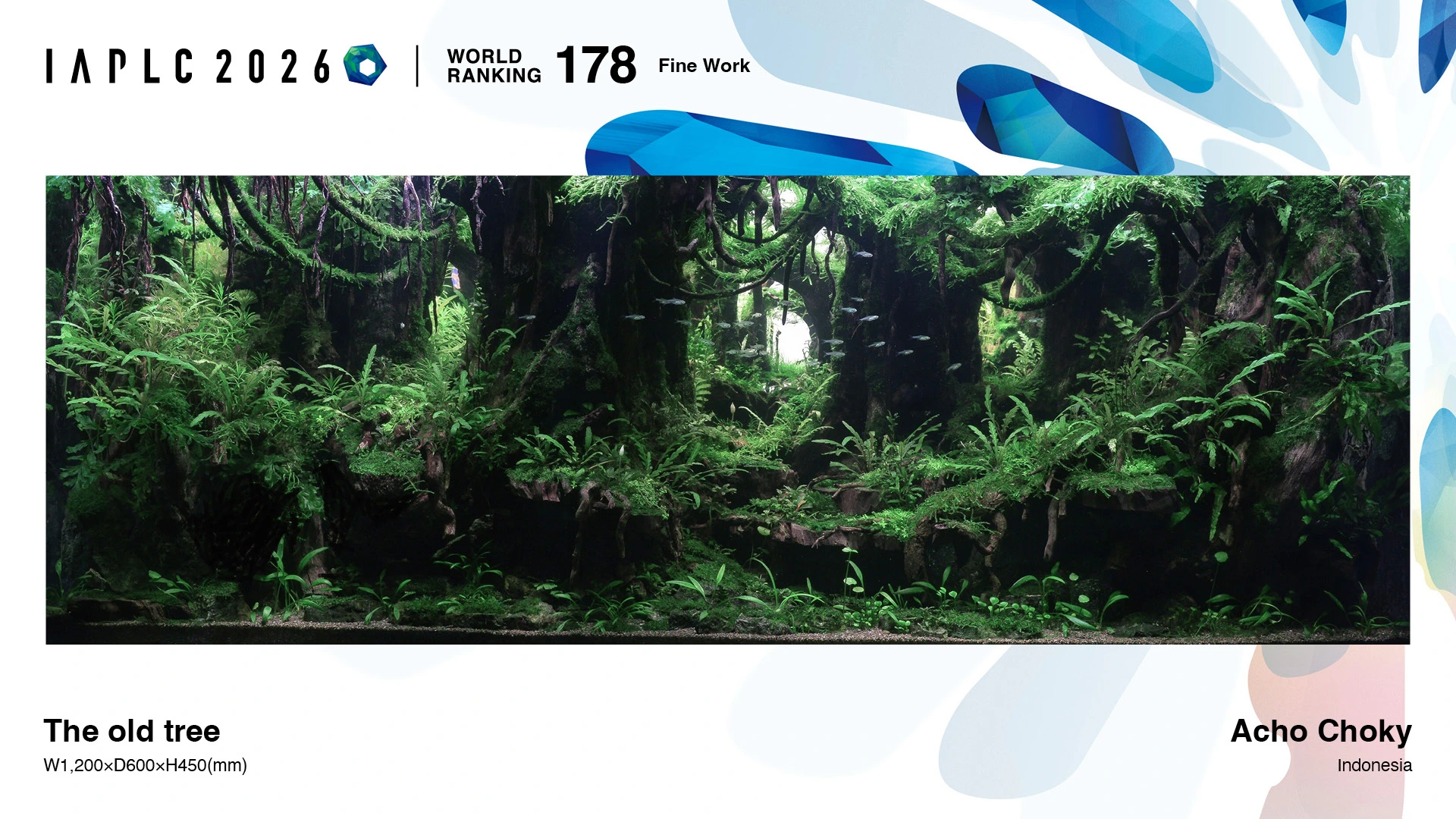
A forest defined by upright rhythm. Dark vertical trunks and hanging growth establish a closely enclosed woodland. A relatively small bright rear area becomes more noticeable because the near structures are so shaded. Fine green foliage gives the spaces around the trunks a different texture, while pale fish can be seen against the darker middle water. The image’s atmosphere comes from the relationship between repeated verticals, small light windows and the vegetation between them.
Look closer: Look for differences in spacing between the trunks.
Explore Acho Choky’s recorded work on AquaRank · Back to the selected works
Rank 206 — Aditia Eko Saputro

Wood and rock leave a central water interval. Dark rocks and wood frame green-planted slopes, with hanging forms above a brighter middle. The visible central interval gives the scene a comparatively open route through otherwise busy hardscape. Small fish can be read near the upper-left dark structure, while the near ground remains textured with low planting. The combination shows how a woodland frame can coexist with substantial stone and a clearly separated water plane.
Look closer: Read the central interval as a space between structures, not simply an empty patch.
Discover aquascapers on AquaRank · Back to the selected works
What the comparison reveals
Robi Chen’s aquarium gives surface leaves and the fish group a large visual role. Danang Cahyo Nugroho anchors a rising scene with a substantial trunk. Acho Choky builds atmosphere from closely spaced vertical forms, while Aditia Eko Saputro combines stone and wood around a more clearly separated middle interval. Woodland imagery remains relevant, but it takes several forms.
The more revealing question is how craftsmanship leaves space to read the image. An elaborate branch can be effective when it clarifies a layer or frames occupied water; its complexity alone tells us little. These four images are all the Indonesian records within this cutoff, not all Indonesian submissions and not a survey of other contests or the wider community.
A design exercise to take away
Compare the largest near structure with the water beside it. Does the structure orient the viewer, frame activity or conceal a route? Give each main element a visible purpose.
All published places at ranks 1–300
| World rank | Published name | Country / area |
|---|---|---|
| 90 | Robi Chen | Indonesia |
| 129 | Danang Cahyo Nugroho | Indonesia |
| 178 | Acho Choky | Indonesia |
| 206 | Aditia Eko Saputro | Indonesia |
Continue through the archive
Revisit the original Indonesia introduction, then open the IAPLC 2026 gallery to view the selected works at full size and keep browsing beyond them. For a related reading, explore our CIAC 2026 podium analysis, including Acho Choky.
Keep exploring with AquaRank Nations. Open Indonesia’s country overview to move from this season’s photographs to recorded results across available competitions and years. Start with the 2026 IAPLC result, choose an earlier available edition, and follow a creator whose work catches your attention. Country overviews keep competition and edition context visible; they do not combine raw ranks from different contests into one overall score.
Which Indonesian creator would you investigate next beyond this article’s Top 300 selection?






Leave your comments