Judge's scorecard
Judging basis: IAPLC Secondary Screening Judging Criteria. The score is an editorial assessment from the submitted image, not an official contest result.
Overall impression and coherence: 23/25
The image communicates a unified submerged-forest concept through consistent use of branching wood, green planting, reflective openings and fish movement. Dramatic contrast increases impact, but very dark areas and intense highlights reduce legibility.
Strengths: Clear and memorable environmental concept; Plants, hardscape and livestock appear to support one visual narrative; Strong atmosphere and immediate photographic impact
Limitations: Some wood and planting details disappear into shadow; Bright openings compete with the central scene; The overall image can feel visually intense rather than fully controlled
Composition, balance and use of space: 22/25
Layered branches create depth, framing and a strong horizontal flow. The central passage and fish provide directional movement, while open cavities prevent the hardscape from becoming completely closed. Several overlapping openings create a less decisive hierarchy than the score’s maximum would require.
Strengths: Effective foreground, middle-ground and canopy layering; Good balance between the heavy left structure and right-side projection; Negative spaces create depth and habitat-like enclosure
Limitations: Multiple upper branches compete for attention; The main focal route is not immediately obvious; Some bright gaps draw attention away from the central planting
Planting, color and natural expression: 18/20
The dense green planting is visually integrated with the wood and produces convincing natural expression. Texture varies across the scene, although the image does not permit species, health history or maintenance claims to be verified.
Strengths: Consistent green palette suits the forest concept; Planting softens and integrates the hardscape; Variation in foliage texture supports scale and depth
Limitations: Dense areas merge and reduce individual form clarity; The image cannot verify long-term plant health; More selective trimming could improve separation between layers
Hardscape and technical execution: 18/20
The extensive branching wood creates shelves, bridges and cavities with strong perspective. Stones and low growth support the lower streambed effect. Hidden construction, attachment and stability cannot be judged from the image, and deep shadows conceal some joins.
Strengths: Ambitious multi-level wood structure; Convincing integration of planting with hardscape; Foreground materials reinforce the environmental narrative
Limitations: Some structural junctions are difficult to inspect; Technical stability and hidden supports are unverifiable; Dark exposure limits assessment of fine craftsmanship
Originality and long-term viability: 8/10
The large-scale submerged woodland treatment is distinctive and memorable. The layout appears demanding to maintain because of its extensive wood surfaces and dense planting, but no maintenance or duration evidence is available.
Strengths: Distinctive canopy-and-stream interpretation; Strong sense of scale and habitat; Memorable combination of hardscape, planting and fish
Limitations: Long-term control of dense planting is uncertain; The complex structure may carry a high maintenance burden; Viability beyond the photographed moment cannot be confirmed
Judge's overall verdict
An exceptionally resolved and distinctive driftwood aquascape with convincing habitat structure, strong depth, and a memorable natural-forest impression. The editorial estimate of 89/100 reflects excellent visible technique and composition. Points are withheld mainly because species compatibility, maintenance history, hidden construction, and some shadowed details cannot be confirmed from the submitted image, while the upper structure slightly outweighs the foreground.
Assessment limits: This assessment is based on one image only. No contestant identity, country, work title, plant or fish taxonomy, dimensions, maintenance records, equipment details, construction methods, or official judging information are visible or supplied. The score is an editorial estimate and is not an official contest result.
Recreation of Natural Habitat for Fish
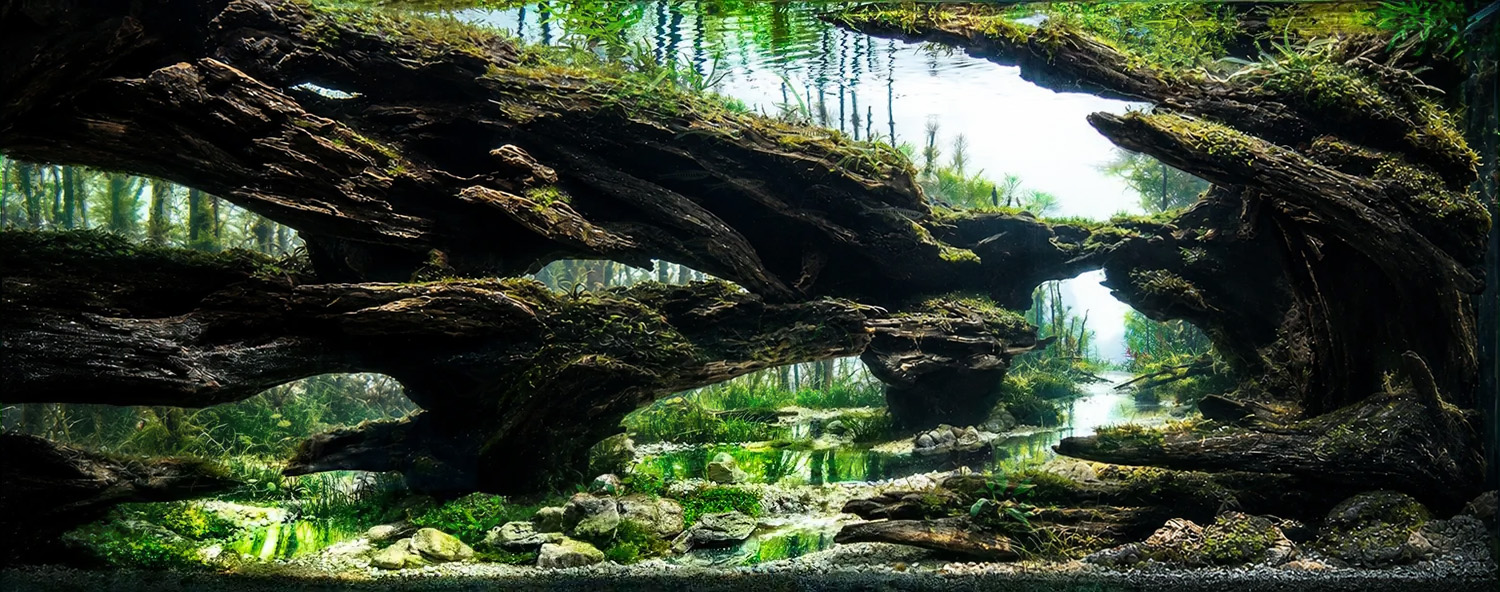
The layout convincingly suggests a submerged woodland or root-filled stream margin. The overlapping wood provides cover, shaded passages, and open swimming lanes rather than forming a single decorative centerpiece. The fish are visibly schooling in the middle zone, where the pale background makes their bodies readable without overwhelming the structure. Plant growth is distributed across wood, substrate, and rear areas, creating a layered underwater environment. These are strong habitat cues, although the image does not allow reliable identification of the fish or plants, nor confirmation that their water requirements and social needs are compatible. The very dark cavities may also limit usable space for some occupants. A higher score would require clearer evidence of species-specific suitability, healthier-looking detail in the deepest shadows, and a more legible relationship between fish behavior and the available shelter.
Long-Term Maintenance of the Layout
The presentation shows substantial visual maturity: plants appear established on the wood, the foreground is comparatively open, and the composition has not been obscured by uncontrolled growth. The planted surfaces nevertheless contain many small textures and transitions that would demand careful trimming, attachment, and algae management. Several dark branches and recesses would be difficult to access, while the bright central opening could expose uneven growth if the balance were not maintained. Because this is a single contest image, there is no verifiable evidence of duration, routine care, water quality, or recovery after trimming. The score therefore remains conservative. To improve the apparent long-term sustainability, the creator would need to preserve the open swimming corridors, prevent moss and fine plants from merging into shapeless masses, and keep the substrate transitions clean without sacrificing the natural, aged appearance.
Creator's Technical Skills
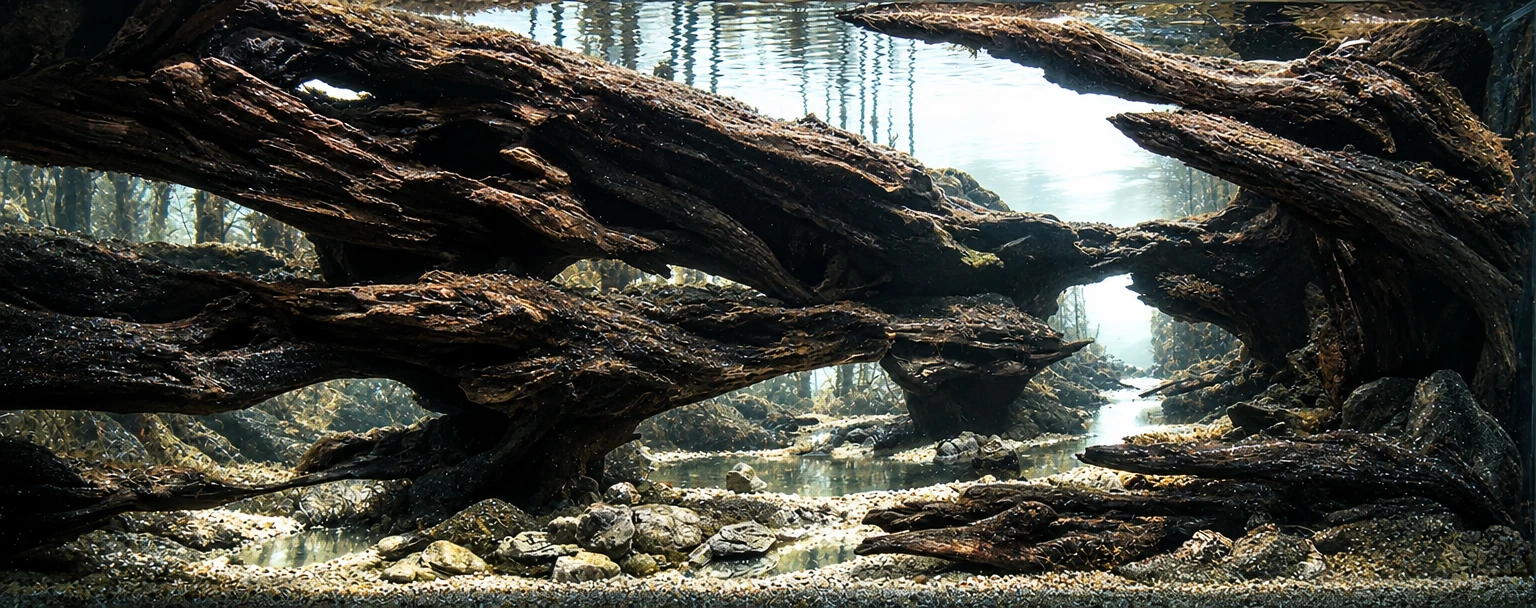
Technical execution is one of the image's clearest strengths. Multiple pieces of driftwood are aligned into broad arches and shelves, producing depth through overlapping silhouettes and carefully controlled openings. Planting follows the wood instead of simply filling the tank, with growth used to soften edges, reinforce the upper canopy, and connect separate structural elements. The pale rear opening and darker foreground establish convincing depth, while the central school provides scale. The scene also demonstrates restraint in leaving sections of substrate and water visible. The main limitation is that the photograph cannot reveal stability, attachment methods, filtration, or the work required to maintain the unusual wood arrangement. Some black areas lose detail, making it harder to judge whether every transition is intentionally finished. More readable shadow detail and a slightly cleaner separation between foreground planting groups would make the technical accomplishment easier to assess.
Originality and Impression
The first impression is strong because the work transforms driftwood into a continuous overhead and lateral structure rather than presenting one conventional mound or isolated tree form. The repeating arches create a memorable visual identity, and the contrast between nearly black wood, vivid green growth, and luminous background gives the image immediate drama. The school of fish adds movement at the focal intersection of the branches. Its originality comes less from a single unusual object than from the scale and continuity of the constructed woodland framework. The risk is that the spectacle of the upper wood dominates the quieter foreground, and the intense contrast can make some details feel photographic rather than naturally observed. A higher score would come from giving the lower landscape a slightly stronger individual narrative while retaining the distinctive canopy and avoiding additional visual clutter.
Presentation of Natural Atmosphere
The image communicates an atmosphere of submerged forest with convincing light variation. Brightness behind the branches resembles an opening or shallow-water clearing, while the dark wood and moss-covered surfaces suggest older, shaded habitat. Reflections and vertical plant forms in the background add an impression of water depth, and the fish help the scene read as an ecosystem rather than a static botanical display. The atmosphere is especially effective where small plants emerge from the wood and where open water separates the structural layers. However, the lighting is highly contrastive: deep shadows conceal some planting and make the scene appear more theatrical than evenly observed. Since no surrounding context or movement is available, the natural reference remains interpretive. Softer shadow information and more consistent visibility across the lower corners could make the passage of time and ecological continuity feel even more credible.
Overall Composition and Planting Balance
The composition is organized by a powerful horizontal canopy, with the central fish group acting as a focal point inside the main opening. Secondary gaps on the left and right prevent the wood from becoming a solid wall, while the brighter rear zone creates recession behind the darker foreground. Planting is generally balanced across the upper branches, middle shelves, and substrate, and the exposed stones help articulate the lower plane. The principal weakness is visual weight: the upper and side wood masses are so dominant that the foreground can read as a supporting strip rather than an equal compositional layer. Very dark corners also reduce the clarity of the outer boundaries. A more graduated foreground, clearer low planting masses, or modestly increased detail in the shadowed edges could improve balance without weakening the dramatic tunnel effect.





Leave your comments