It’s time to help contribute for biggest aquarium gallery online

SUBMIT HEREVIEW GALLERY

Paracheirodon simulans (Blue Neon Tetra)

Overview

The Blue Neon Tetra (Paracheirodon simulans), frequently referred to in the hobby as the Green Neon Tetra, is a spectacular micro-fish beloved by aquarists. Though slightly smaller and more sensitive than the standard Neon Tetra, its vibrant, full-length iridescent stripe makes it a highly sought-after species for planted nano aquariums and biotope setups.

Image of blue neon paracheirodon simulans

Distribution and Habitat

This species is native to the upper Rio Negro and Rio Orinoco basins in South America. They naturally inhabit sluggish, highly acidic blackwater tributaries that are deeply stained with tannins from decaying leaves, branches, and organic matter. These waters are typically very soft and warm, shaded by dense rainforest canopies.

Description of Blue Neon Tetra

Body shape:

They possess a slender, elongated, and laterally compressed body that is perfectly adapted for darting through dense aquatic vegetation.

Color:

Their defining feature is a brilliant, continuous iridescent stripe that shifts between neon blue and green depending on the lighting. Unlike the common Neon Tetra, this stripe extends all the way from the nose to the base of the tail. The red coloration on their lower half is very faint or entirely absent, while the belly is a silvery-white.

Barbels:

They do not have barbels.

Snout:

The snout is short and relatively blunt, featuring a small terminal mouth designed for capturing tiny prey.

Eyes:

The eyes are large in proportion to their body, featuring a bright, reflective blue patch on the upper iris.

Fins:

All of their fins (dorsal, anal, pelvic, and pectoral) are mostly transparent and colorless.

The Tail:

The caudal fin is distinctly forked and completely transparent, aiding in their quick, agile movements.

Image of blue neon paracheirodon simulans

Temper

They are exceptionally peaceful, docile, and somewhat timid fish. They do not bother other tank mates and are easily intimidated by larger or boisterous species.

Sociality

Blue Neon Tetras are highly gregarious schooling fish. To feel secure and display their best colors and natural behaviors, they must be kept in groups of at least 8 to 10 individuals. Larger schools of 20 or more create a breathtaking visual display.

Activity

They are mid-level swimmers that remain highly active during the day. You will often see them darting around the tank in tight, coordinated schools, especially when exploring open swimming spaces.

Keeping and Caring for Blue Neon Tetra

Tank size:

A minimum of 10 gallons (about 40 liters) is required for a small school, though larger tanks are always better to maintain stable water parameters.

Water Parameters:

Temperature

They prefer distinctly warmer water than standard neons, thriving between 24-30°C (75-86°F).

pH

They require highly acidic water to truly thrive, with an ideal pH range of 5.0 to 6.5.

Hardness

Water should be very soft, ideally between 1 and 5 dGH.

Ammonia, Nitrite, Nitrate

Ammonia and Nitrite must always be at 0 ppm. Nitrates should be kept strictly below 20 ppm through regular water changes, as they are sensitive to poor water quality.

Lighting

Dim to moderate lighting is preferred. Floating plants are highly recommended to diffuse bright aquarium lights and mimic their shaded natural habitat.

Water flow

They appreciate a gentle to sluggish water flow. Harsh currents will stress these small fish.

Decorations and Plants

A densely planted tank with driftwood, dark substrate, and leaf litter (such as Indian Almond leaves) is ideal. The tannins released by botanical materials will help lower the pH and bring out their most vibrant colors.

Image of blue neon paracheirodon simulans

Diet

In the wild, they are omnivorous micro-predators feeding on tiny invertebrates. In the aquarium, they will readily accept high-quality crushed flakes, micro-pellets, and small live or frozen foods such as baby brine shrimp, daphnia, and cyclops.

Some Feeding Tips

Feed them small amounts 1 to 2 times daily. Because they have very small mouths, ensure that any dry food is crushed finely enough for them to easily consume.

Breeding

Breeding the Blue Neon Tetra in captivity is considered difficult due to their strict water parameter requirements. They are egg-scatterers that need extremely soft, highly acidic water (pH 5.0-5.5) and very dim lighting to trigger spawning. A separate breeding tank is necessary, and parents must be removed immediately after spawning to prevent them from eating the eggs. The fry are microscopic and require infusoria as their first food.

Conclusion

The Blue Neon Tetra is a dazzling and rewarding addition to a peaceful, soft-water aquarium. While they demand slightly stricter water parameters and warmer temperatures than other beginner tetras, their brilliant, glowing schooling behavior in a blackwater or heavily planted setup makes them one of the most beautiful micro-fish in the aquarium hobby.
Fish info

Care level: Moderate
Temperament: Peaceful
Adult size: 2-2.5 cm
Life expectancy: 3-5 years
Fish type: Tetra
Temperature : 24-30°C
pH: 5.0-6.5
Color Form: Blue, Green, Silver
Leave your comments
Lastest on Fishs
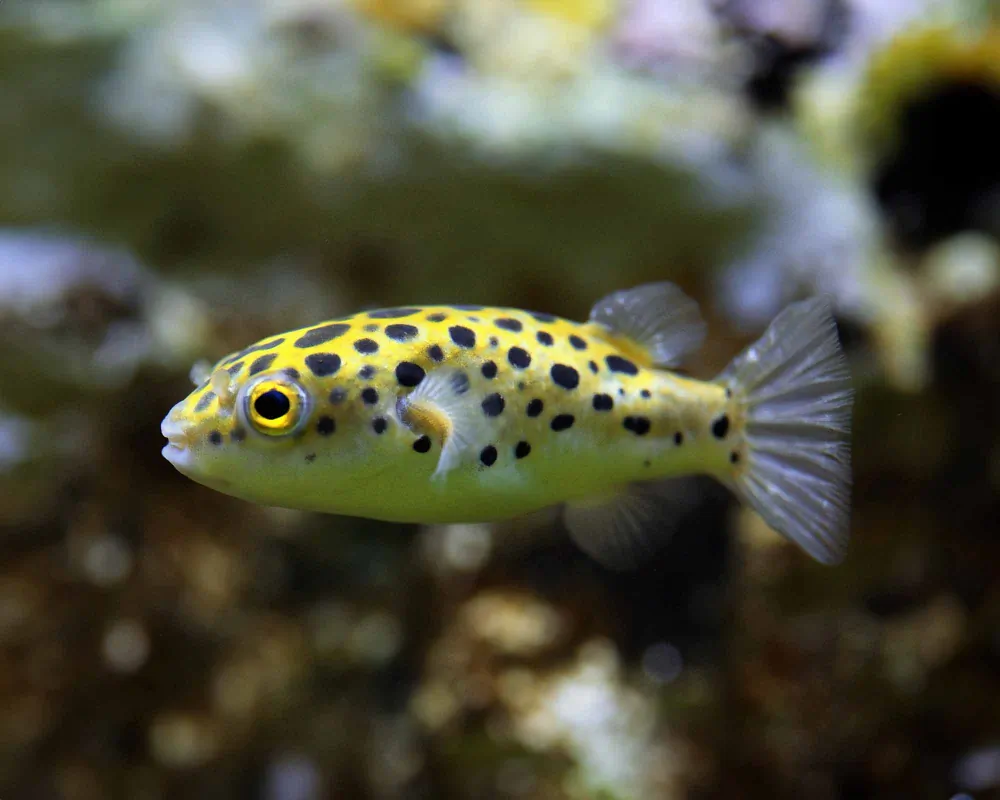
  • Tetraodon nigroviridis (Green Spotted Puffer)

    Difficult
    Tetra
    Hailing from the coastal estuaries of Southeast Asia, the Green Spotted Puffer is a highly intelligent and interactive fish. Famous for its vibrant green-yellow coloration and distinct black spots, this brackish-water species demands specialized care but rewards dedicated aquarists with its unique, puppy-like personality and fascinating hunting behaviors.
  • Leporinus affinis (Banded Leporinus)

    Moderate
    Tetra
    The Banded Leporinus (Leporinus affinis) is a striking, torpedo-shaped freshwater fish native to the vibrant rivers of South America. Known for its bold black and yellow stripes, this active and intelligent species adds a dynamic presence to large aquariums, captivating aquarists with its unique head-down swimming behavior and energetic personality.
  • Epalzeorhynchos frenatum (Green Fringe Lark / Rainbow Shark)

    Moderate
    Tetra
    The Green Fringe Lark, widely known as the Rainbow Shark, is a striking freshwater cyprinid native to Southeast Asia. Famous for its vibrant red fins contrasting against a dark body, this semi-aggressive bottom-dweller brings dynamic activity to large aquariums, though its territorial nature requires careful tank mate selection.
  • Tetraodon mbu (Mbu Pufferfish)

    Expert Only
    Tetra
    The Mbu Pufferfish, native to the Congo River basin, is a true freshwater giant known for its striking maze-like patterns and highly intelligent, interactive personality. Due to their massive adult size and specialized diet, they are highly sought after but require expert care and enormous aquariums to thrive.
  • Osteoglossum bicirrhosum (Golden Arowana)

    Expert Only
    Tetra
    The Golden Arowana, a rare color variant of the South American Silver Arowana (Osteoglossum bicirrhosum), is a breathtaking centerpiece for giant aquariums. Known for its predatory prowess and incredible jumping ability, this surface-dwelling giant demands pristine water, massive tank space, and expert care, making it highly prized among advanced aquarists.
  • Brachydanio rerio (Golden Zebra Danio)

    Easy
    Tetra
    The Golden Zebra Danio is a striking, active color morph of the classic Zebra Danio. Originating from selective breeding of wild populations in South Asia, this energetic schooling fish is highly popular among aquarists for its hardiness, peaceful nature, and beautiful golden stripes, making it perfect for community tanks.
  • Aplocheilus lineatus (Golden Striped Pike)

    Easy
    Tetra
    The Golden Striped Pike, a stunning gold morph of the Striped Panchax, is a hardy and vibrant top-dwelling killifish. Originating from India but widely captive-bred in Europe, this active predator boasts a striking metallic yellow body. Its peaceful yet opportunistic nature makes it a fascinating addition to community aquariums.
  • Hemigrammus bleheri (Golden Redhead Tetra)

    Moderate
    Tetra
    Hailing from the blackwater rivers of South America, the Golden Redhead Tetra is a striking variant of the classic Rummy-nose Tetra. Renowned for its brilliant ruby-red facial coloration and shimmering golden body, this peaceful schooling fish adds vibrant energy and captivating beauty to any well-planted community aquarium.
  • Chonerhinus modestus (Golden Pufferfish)

    Moderate - Difficult
    Tetra
    The Golden Pufferfish (Chonerhinus modestus), also known as the Bronze Puffer, is a highly active and captivating species native to Southeast Asia. Known for its striking metallic gold coloration, this intelligent but aggressive freshwater puffer requires a dedicated aquarist to manage its specialized diet and fin-nipping tendencies.
  • Megalomphodus roseus (Golden Phantom Tetra)

    Easy
    Tetra
    The Golden Phantom Tetra (Megalomphodus roseus), native to the shaded forest streams of South America, is a captivating and peaceful schooling fish. Known for its distinct black shoulder spot and subtle golden-yellow hues, this active tetra adds a lively, shimmering dynamic to any planted community aquarium.
  • Gymnocorymbus ternetzi (Golden Mourning Tetra)

    Easy
    Tetra
    The Golden Mourning Tetra, a captivating color morph of the popular Black Skirt Tetra, originates from South America. Known for its shimmering, translucent golden hue and hardy nature, this peaceful schooling fish is incredibly popular among both beginner and experienced aquarists seeking an active and resilient community tank addition.
  • Epalzeorhynchos frenatum (Albino Rainbow Shark)

    Moderate
    Tetra
    The Albino Rainbow Shark is a striking freshwater fish renowned for its pale, creamy body and vivid orange-red fins. Originating from Southeast Asia, this semi-aggressive bottom-dweller brings dynamic energy to a well-sized community aquarium. Its shark-like appearance and active scavenging behavior make it a long-standing favorite among aquarists.
  • Nematobrycon palmeri (Golden Emperor Tetra)

    Easy
    Tetra
    The Golden Emperor Tetra is a stunning, captive-bred color morph of the classic Emperor Tetra. Known for its radiant golden hues, striking blue eyes, and graceful finnage, this peaceful schooling fish adds a touch of elegance to any planted aquarium. It is hardy, active, and perfect for community setups.
  • Hemigrammus rodwayi (Gold Tetra)

    Easy
    Tetra
    The Gold Tetra (Hemigrammus rodwayi) is a striking, peaceful freshwater fish native to the rivers of South America. Known for its unique, metallic golden sheen—caused by a harmless skin parasite in the wild—it is a popular, active schooling fish that adds brilliant color to community aquariums.
  • Boraras merah (Gold Spotted Dwarf Danio)

    Moderate
    Tetra
    Hailing from the peat swamps of southern Borneo, the Gold Spotted Dwarf Danio (Boraras merah) is a captivating micro-fish. Loved for its fiery red coloration and peaceful nature, it is a highly popular choice for nano aquariums, bringing vibrant energy and schooling behavior to densely planted blackwater setups.
  • Haludaria fasciata (Glowing Coal Barb)

    Easy - Moderate
    Tetra
    The Glowing Coal Barb, also known as the Melon Barb, is a stunning, highly active cyprinid native to the rivers of southern India. Renowned for its fiery pinkish-red hues and striking black vertical bands, this schooling fish brings a burst of energy and vibrant color to any peaceful community aquarium.