Overview
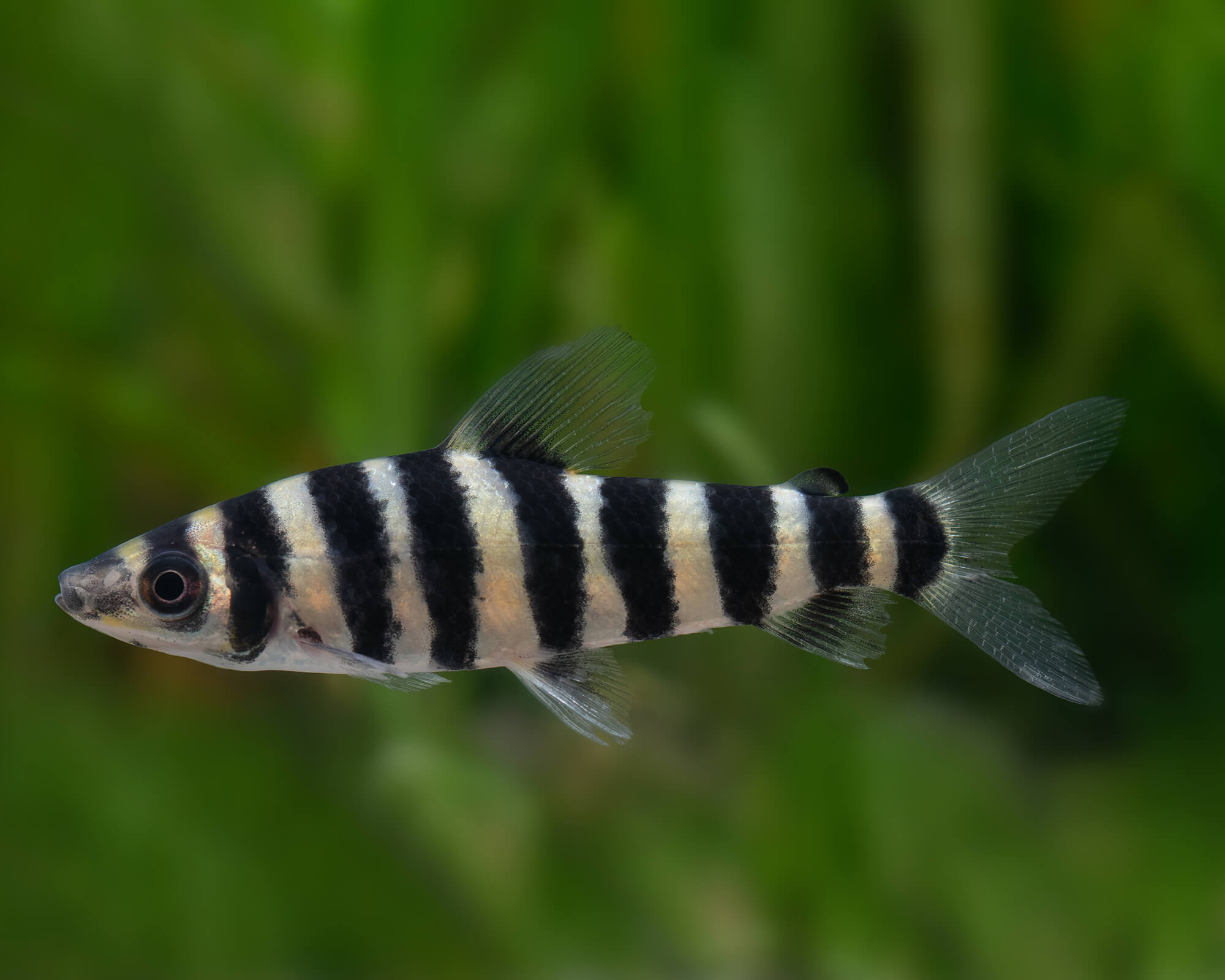
The Banded Leporinus (Leporinus affinis) is a highly recognizable and popular species among freshwater aquarium enthusiasts. Characterized by its striking vertical bands and fascinating "head-down" resting posture, this fish brings both aesthetic appeal and lively behavior to large setups. Due to their size and potential for fin-nipping, they require careful tankmate selection and ample swimming space.

Distribution and Habitat
Native to the expansive river basins of South America, the Banded Leporinus is predominantly found in the Amazon and Orinoco river systems. They inhabit fast-flowing rivers, flooded forests, and rocky streams. In their natural habitat, they are often seen grazing on algae, detritus, and aquatic vegetation, utilizing the dense underwater structures for cover and foraging.
Description of Banded Leporinus
Body shape:
They possess an elongated, torpedo-shaped body designed for swift swimming in moderate to fast currents.
Color:
The body features a base color of pale yellow to cream, intersected by prominent, thick black vertical bands (usually nine in total) that run from the snout to the tail.

Barbels:
They do not possess prominent barbels, relying instead on their specialized mouths for grazing.
Snout:
The snout is somewhat pointed with a small, terminal mouth equipped with prominent, incisor-like teeth adapted for clipping vegetation and scraping algae.
Eyes:
Their eyes are relatively large and positioned laterally, offering a wide field of vision to spot predators and food.
Fins:
The fins are generally translucent or slightly yellowish, with the dorsal fin positioned high on the back.
The Tail:
The caudal fin (tail) is deeply forked, providing powerful propulsion for quick bursts of speed.
Temper
While often peaceful as juveniles, the Banded Leporinus can develop a semi-aggressive temperament as it matures. They are notorious fin-nippers, especially toward slow-moving or long-finned tankmates.
Sociality
In the wild, they are often found in loose shoals. In an aquarium, they can be kept singly or in groups of six or more to disperse aggression. Keeping them in small groups (2-4) often leads to bullying of the weakest individual.

Activity
This is a highly active species that spends much of its time swimming in the middle to lower levels of the tank. They are also known for their curious habit of resting at a 45-degree head-down angle, mimicking sticks or reeds in the water.
Keeping and Caring for Banded Leporinus
Tank size:
Due to their active nature and large adult size (up to 30 cm), a minimum tank size of 125 gallons (475 liters) is recommended for a single adult, with larger tanks required for groups.
Water Parameters:
Temperature
They thrive in tropical temperatures ranging from 22-28°C (72-82°F).
pH
The ideal pH level is slightly acidic to neutral, between 5.5 and 7.5.
Hardness
Water hardness should be kept between 2 and 15 dGH.
Ammonia, Nitrite, Nitrate
Ammonia and Nitrite must be strictly at 0 ppm. Nitrates should be maintained below 20 ppm through regular water changes and efficient filtration.
Lighting
Moderate lighting is preferred, simulating the dappled light of their native flooded forest habitats.
Water flow
They appreciate moderate to strong water flow, which mimics their natural riverine environments and provides exercise.
Decorations and Plants
Provide plenty of open swimming space alongside driftwood, rock caves, and sturdy decorations. Be cautious with live plants, as their herbivorous tendencies mean they will likely eat soft-leaved plants. Tough plants like Anubias or Java Fern may survive.

Diet
The Banded Leporinus is an omnivore with a strong preference for plant matter. In captivity, they should be fed a high-quality spirulina or vegetable-based pellet, supplemented with blanched vegetables like zucchini, peas, and spinach, as well as occasional meaty foods like bloodworms or brine shrimp.
Some Feeding Tips
Feed them 1-2 times daily, offering only what they can consume in a few minutes. Providing fresh greens regularly helps curb their appetite for any live plants you might have in the tank.
Breeding
Breeding the Banded Leporinus in a home aquarium is extremely rare and difficult. They are egg-scatterers in the wild, requiring specific seasonal triggers such as heavy rainfall, changes in water chemistry, and massive spaces that are hard to replicate indoors.
Conclusion
The Banded Leporinus is a stunning and engaging fish that rewards the dedicated aquarist with its bold patterns and unique behaviors. While their size and potential for nipping require careful planning and a large tank, they make a magnificent centerpiece for a well-curated, robust community setup.




Leave your comments