Overview
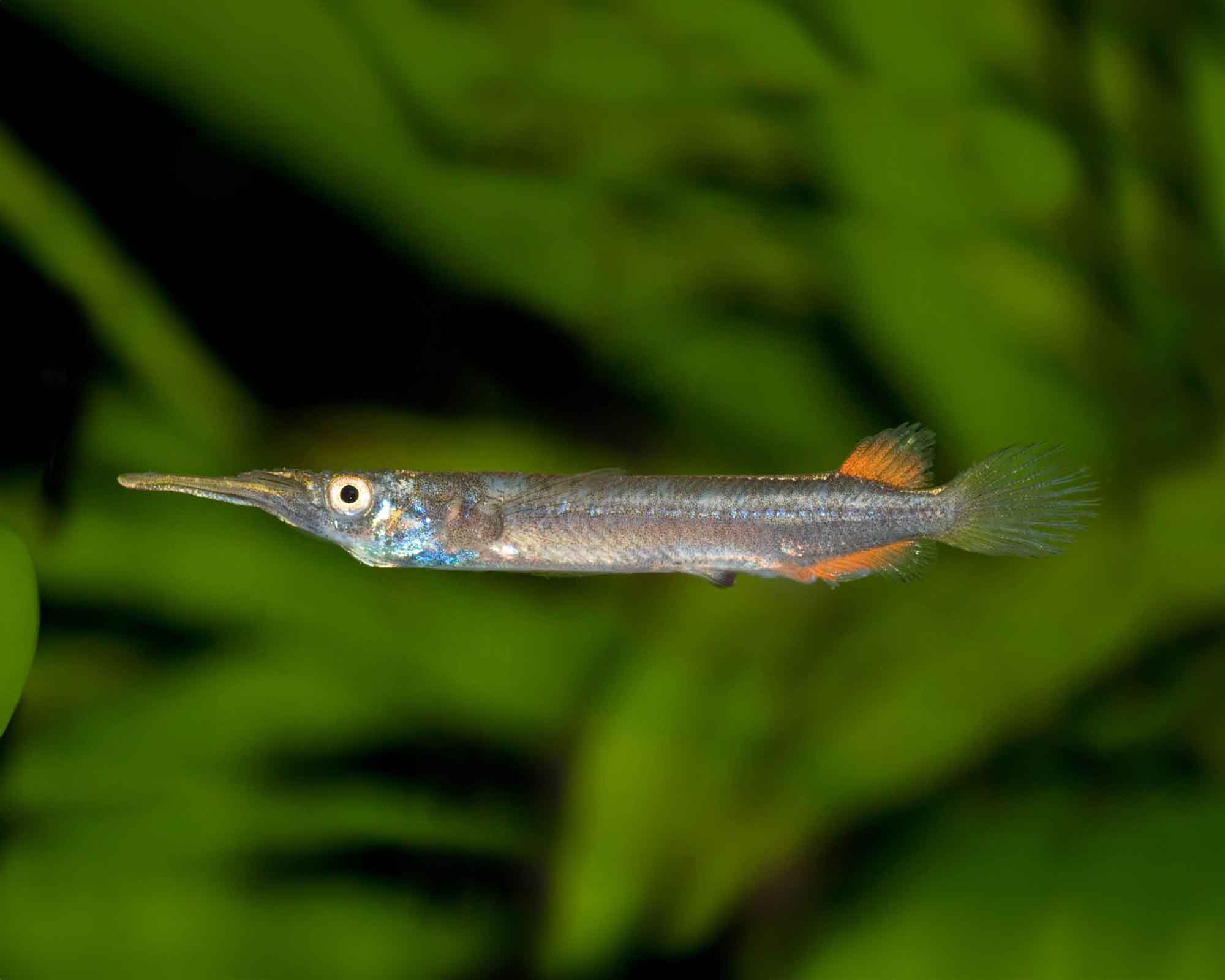
The Half Billed Pike (Dermogenys pusillus), frequently known as the Wrestling Halfbeak, is a uniquely shaped surface-dwelling fish belonging to the family Zenarchopteridae. Admired for their intriguing anatomy and engaging behaviors, these livebearers are a fantastic choice for aquarists looking to add life and movement to the upper levels of their aquarium.

Distribution and Habitat
This species is widely distributed across Southeast Asia, with populations found in Thailand, Malaysia, Indonesia, Singapore, and Vietnam. They inhabit a variety of slow-moving or stagnant waters, including rivers, canals, flooded fields, and mangrove swamps. While primarily a freshwater fish, they are highly adaptable and are often found in slightly brackish environments.
Description of Half Billed Pike
Body shape:
They possess a highly elongated, slender, and somewhat cylindrical body perfectly adapted for cruising just below the water's surface.
Color:
The body is predominantly silvery or clear-grey with a subtle bluish or greenish iridescence. Males often display vivid red, orange, or yellow highlights on their dorsal and anal fins.
Barbels:
This species does not possess barbels.
Snout:
The most defining characteristic is the mouth: the lower jaw is heavily elongated into a rigid "beak," while the upper jaw is significantly shorter and very flexible.
Eyes:
Their eyes are relatively large and positioned near the top of the head, allowing them to spot terrestrial insects on the water's surface as well as aerial predators.
Fins:
The dorsal and anal fins are set far back on the body, near the tail. In males, the anal fin is modified into an organ called an andropodium, used for internal fertilization.
The Tail:
The caudal fin (tail) is typically rounded or slightly truncate, providing quick bursts of speed.
Temper
While generally peaceful towards other species, males are highly territorial and combative with one another. They engage in "wrestling" matches where they lock jaws and struggle for dominance, which gives them their common name. Because of this, they are considered semi-aggressive.
Sociality
They are best kept in groups with a harem structure—ideally one male to three or more females. This helps to disperse the male's aggressive mating and territorial behaviors. They do well in community tanks with other peaceful, similarly sized fish that occupy the middle or bottom levels of the aquarium, such as Corydoras or small tetras.
Activity
Half Billed Pikes are highly active surface dwellers. They spend nearly all their time patrolling the top inch of the water column. They are also notorious jumpers, especially when startled.
Keeping and Caring for Half Billed Pike
Tank size:
A minimum of 20 gallons (75 liters) is recommended. Because they are surface dwellers, the footprint (length and width) of the tank is much more important than the depth.
Water Parameters:
Temperature
They thrive in tropical temperatures ranging from 24-28°C (75-82°F).
pH
A slightly alkaline pH is preferred, ideally between 7.0 and 8.0.
Hardness
They do best in moderately hard to hard water, ranging from 10-20 dGH. The addition of a small amount of marine salt (brackish conditions) can sometimes improve their health but is not strictly necessary.
Ammonia, Nitrite, Nitrate
Ammonia and Nitrite must always be at 0 ppm. Nitrates should be kept low, ideally below 20 ppm, through regular water changes.
Lighting
Moderate lighting is best. If the lighting is too intense, floating plants can be used to diffuse it and make the fish feel more secure.
Water flow
They prefer gentle to moderate water flow. While they enjoy a slight current, there must be calm resting areas at the surface.
Decorations and Plants
Floating plants (like Duckweed, Frogbit, or Water Sprite) are absolutely essential. They provide hiding spots for females and fry, break up lines of sight to reduce male aggression, and prevent the fish from jumping out of the tank. A tight-fitting lid is also mandatory.
Diet
In the wild, they are primarily insectivores, feeding on insects that fall onto the water's surface. In the aquarium, they are carnivorous and should be fed a diet of floating foods. They readily accept high-quality floating flakes or micro-pellets, but their diet should be supplemented with live or frozen foods like fruit flies (Drosophila), mosquito larvae, bloodworms, and Daphnia.
Some Feeding Tips
Because of their specialized jaw structure, they physically struggle to eat food that sinks below the surface. Always ensure that the food provided floats for a sufficient amount of time for them to consume it.
Breeding
Breeding the Half Billed Pike is possible but can be challenging. They are viviparous (livebearers). After a gestation period of roughly 3 to 6 weeks, the female will give birth to 10 to 20 relatively large fry. The fry are fully formed and will immediately seek cover at the water's surface. Adult Halfbeaks will cannibalize their young, so dense floating plant cover is required, or the pregnant female should be moved to a separate birthing tank. The fry can be fed newly hatched brine shrimp or powdered fry food immediately.
Conclusion
The Half Billed Pike is a captivating and highly specialized fish that brings a unique dynamic to the home aquarium. While their specific dietary and surface-level needs require a bit of extra attention, their fascinating appearance and engaging social behaviors make them a highly rewarding species for the dedicated aquarist.




Leave your comments