Overview
The Cherry Spotted Tetra, most commonly referred to in the aquarium hobby as the Bleeding Heart Tetra, is a highly sought-after species due to its unique coloration and peaceful demeanor. As a larger tetra species, they make an excellent centerpiece schooling fish for mid-to-large sized community aquariums.

Distribution and Habitat
This species is native to the Upper Amazon River basin, predominantly found in Colombia, Peru, and Brazil. They inhabit slow-moving forest streams and tributaries that are heavily shaded by dense canopy cover. These waters are typically stained brown with tannins from decaying organic matter, creating a soft, acidic blackwater environment.
Description of Cherry Spotted Tetra
Body shape:
They possess a deep, laterally compressed body typical of many larger tetras, giving them a somewhat diamond-like or disc-shaped profile.
Color:
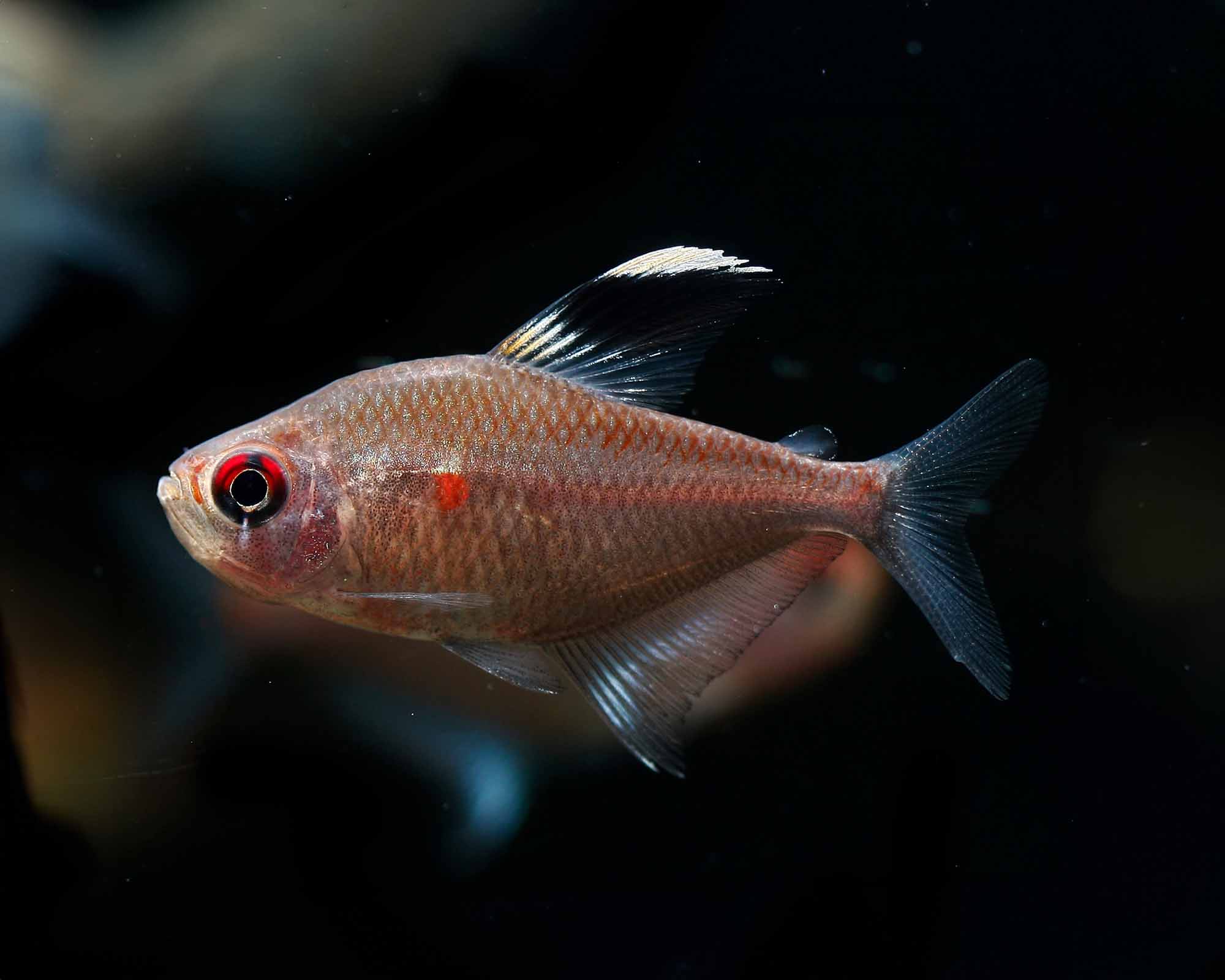
The body is predominantly a shimmering silver with a delicate pink or beige wash. Their most distinguishing feature is a bright, blood-red spot located centrally on the flanks.
Barbels:
Like all characins, this species does not possess barbels.
Snout:
The snout is relatively short and blunt, equipped with a small, terminal mouth suited for picking small foods from the water column.
Eyes:
The eyes are comparatively large, featuring a striking red crescent in the upper half of the iris that complements their flank spot.
Fins:
Males develop a stunning, elongated dorsal fin that arches gracefully, prominently edged in black and white. The anal fin is also quite long and features a white leading edge.
The Tail:
The caudal (tail) fin is deeply forked and generally translucent with a subtle dusky or reddish tint.
Temper
They are generally very peaceful, though males may occasionally engage in harmless sparring displays to establish hierarchy and impress females. They will not bother other appropriately sized tank mates.
Sociality
This is a highly gregarious schooling fish. They must be kept in groups of at least 6 individuals, though larger schools of 10 or more will encourage their best behaviors and most vibrant coloration.
Activity
Cherry Spotted Tetras are active mid-level swimmers. They spend the majority of their day cruising the middle strata of the aquarium, occasionally darting into plant cover if startled.
Keeping and Caring for Cherry Spotted Tetra
Tank size:
Due to their active nature and relatively large size for a tetra, a minimum tank size of 20 gallons is required, though a 30-gallon (or larger) aquarium is highly recommended for a proper school.
Water Parameters:
Temperature
Maintain the water temperature between 22-28°C (72-82°F) to mimic their tropical habitat.
pH
They thrive in slightly acidic water, with an ideal pH range of 5.5 to 7.0.
Hardness
Soft water is preferred, ideally kept between 2 and 15 dGH.
Ammonia, Nitrite, Nitrate
Ammonia and Nitrite must always be at 0 ppm. Nitrates should be kept strictly below 20 ppm through regular water changes, as they are sensitive to declining water quality.
Lighting
Dim to moderate lighting is best. Bright lights can wash out their colors and make them skittish. Floating plants are excellent for diffusing intense light.
Water flow
A gentle to moderate water flow replicates the slow-moving streams of their natural environment without exhausting them.
Decorations and Plants
A biotope setup is ideal, featuring a dark sandy substrate, driftwood tangles, and dried botanicals like Indian almond leaves. Dense planting along the back and sides will provide security while leaving the center open for swimming.
Diet
They are omnivorous and not particularly fussy. A high-quality flake or micro-pellet should form the staple of their diet. Supplement this with regular feedings of live or frozen foods such as daphnia, bloodworms, and brine shrimp to enhance their red coloration.
Some Feeding Tips
Feed small amounts 1 to 2 times daily, only providing what the school can consume within a couple of minutes to prevent water fouling.
Breeding
Breeding the Cherry Spotted Tetra in a home aquarium can be challenging. They are egg scatterers that require a dedicated breeding tank with very soft, acidic water (pH 5.5-6.0), dim lighting, and fine-leaved plants or a spawning mop. Adults will eat their own eggs, so they must be removed immediately after spawning. The fry are tiny and require infusoria before graduating to microworms or baby brine shrimp.
Conclusion
The Cherry Spotted Tetra is a magnificent and robust fish that brings a splash of dramatic color to the freshwater aquarium. Provided with clean, soft water and a peaceful community of tank mates, their "bleeding heart" will be a mesmerizing focal point for years to come.



Leave your comments